|
Sockdolager hove-to under storm trysail, 100 miles off the Oregon coast
at the beginning of the gale. |
Because a lot of
people have asked us about the traditional way of “parking” your boat on
the ocean, called heaving-to, and because so many have also asked, Are you going to write a book about the
voyage, (and because I am writing
one,) here is a compilation of story and technical information about
heaving-to, from a couple of draft chapters and an appendix. We've also posted three videos.
They are:
1. Sockdolager hove-to off the Oregon coast;
2. Sockdolager hove-to off New Zealand; and
3. A side-by-side split-screen comparison of conditions in the two videos.
We hope this post helps to answer some of those technical questions
while also telling a story for our non-technical readers.
On July 22, 2011, we
were hove-to 100 miles off the Oregon coast, waiting out a gale. We
remained hove-to for 48 hours. Every so often a big wave collapsed squarely
onto the windward side of the hull, punching us—BAM!—like a heavyweight
prizefighter. It shoved the boat nearly onto her side. The first time it
happened, Jim was bracing himself in the galley and I was laying in his settee
bunk. At impact I tensed for a knockdown. Stay
up, stay up, stay up! I beamed
strength to the boat; the rolldown lost momentum at about 50 or 60 degrees off
vertical. Then the heavy weight and leverage of Sockdolager’s keel began
righting us. Ah, whew, we’re okay. But if
these waves get any bigger, we won’t be.
Twenty-four hours
previous, the thought of being at the mercy of a gale coming with so little
warning had caused my mind to briefly race toward panicky paralysis, until I
forced it to stop and come to attention. What
are you afraid of, I asked silently. Of
being smashed by wind and huge seas in these cold waters, the fear
answered, of not being in control.
Are you afraid the boat can’t cope? No,
she’s a solid little thing. Is a 35-knot gale something you can’t cope with? No, I’ve seen them before. Is it because
of the reputation of this coast? Yes. The
seas are supposed to be worse here. And there are no harbors of refuge. Well,
what can you do about it? Stay offshore,
reef the sails and heave-to. Secure everything in the cabin that could fly around,
and remember you got through a gale in the Gulf of Alaska just fine. What
else? Act calm. Keep to normal routines.
Discuss all those plans you and Jim made for situations like this. You’ll
do fine, I told myself.
 |
| Rising seas off the Oregon coast a day before we hove-to. |
Before we’d hove-to we
had been running before the wind and seas, an option that might have remained viable except for one thing: a stronger gale was forming to our south, off Cape
Mendocino. If we continued sailing south, we would risk running into that at a
time when we would also be running out of sea-room on an inhospitable coast.
Bad as it sounded, we needed to try and stay put to avoid the stronger gale to
the south. Sea-room is like money in the bank, it’s safety. We’d sailed 100
miles offshore as a deliberate coping strategy for exactly these circumstances,
because you need plenty of sea-room with a ragged coast from Washington through
Northern California forming a dangerous lee shore. Fetching up on surf-tossed
rocks is rarely survivable, so the closer we got to the coast, the more nervous
we’d get.
 |
| A beautiful but inhospitable coast, a dangerous lee shore. This is why we sailed 100 miles offshore. Photo credit: Wikipedia. |
At first we hove-to using a double reefed mainsail and a
small scrap of genoa, but we soon rolled up the genoa because the boat was heeling
too much and wasn’t heading up enough into the wind. Our mainsail is relatively
small, so its second reef is where most sailmakers put a third one. But we were
still heeled over too far, and with the tiller hard over the boat still
wouldn’t point much higher than a beam reach, so we rigged the storm trysail,
hoping that would make the difference. The boat heeled less and we pointed a
tad higher, but we remained beam-on to the seas for too much of the time.
Here’s a video of
Sockdolager hove-to in the early stages of the gale off Oregon. We didn’t
get any video of the heart of the gale because it happened at night. We also stayed hove-to for an extra twelve
hours because the gale to our south was still blowing, and we didn’t want to
run into it. Besides, it was still blowing thirty knots where we were, so why not wait for it to settle. It's worth noting that the lens on the snapshot camera we used makes waves look a lot smaller than they are. Not that we're playing our violins, but when we watched these videos for the first time, neither of us felt that they showed the seas as high as they really were. Also, some seas are cresting in this video, but none had begun to break and tumble. Two more videos follow, further down this post.
The idea behind heaving-to is to use the sails and rudder to “park” the boat so it
rides at a 45 to 60 degree angle to wind and waves, presenting a relatively
small target (the bow) to the seas. Heaving-to stops headway and reduces crew discomfort,
so that you can rest, cook and eat a meal, change or reef sails more safely, or
do more intricate tasks like connecting to a Ham radio net.
 |
| Heaving-to diagram. Credit: Wikipedia. |
Although the change to less motion and noise is immediate,
heaving-to doesn’t stop all movement; properly positioned, the boat will drift
directly downwind at about half a knot to a knot. Fin keeled boats will make
more leeway (slippage sideways) than
boats with full keels. As the boat is pushed downwind, the water it passes over
smoothes out when it emerges at the surface next to the boat’s upwind side. This
is called its “slick,” though no oil is involved. Whether the effect is an
apparent increase in surface tension as the boat “combs” through the water and flattens this
small patch just to windward, or some other reason, it damps down
waves threatening to break over the boat. They’ll break all around, but rarely
over it. The trick is to stay in that slick area of water by drifting dead
downwind and not moving ahead, out of its protection.
If when hove-to, the bow doesn’t point high enough into the
wind, the boat’s sails will fill and cause it to accelerate forward and out of
position (called fore-reaching.) A boat that’s fore-reaching will make headway
and escape its slick. Note how at the end of the above video the GPS shows our speed accelerating from 0.7 to 2.3 knots. That's fore-reaching. Unless waves are breaking or you are threatened with
being blown onto a lee shore, this may not matter a lot. But off this coast you
can have both threats, so being able to stop the boat is important. Since we had plenty of sea-room and were to windward of our course line, our goal was to outwait the stronger gale to our south while staying on course as best we could.
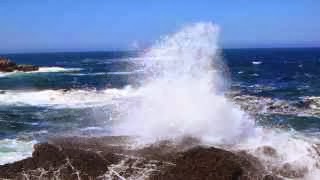 |
| A windy day and no harbor = stay well offshore! |
Wind speeds given in
marine weather forecasts can often be lower than what you get in reality,
and forecasts give sea size as the “significant” wave height, which is an average of the
highest one-third of all waves in that area. This means about half the waves
will be less than the significant height. But because intersecting
wave crests sometimes combine to form higher waves, about ten percent of the
seas will be 25 to 30 percent higher than “significant.” One percent will be
two-thirds higher, and about once per hour a wave will be almost twice the
significant height. So if the forecast says “Seas ten feet,” then you should
expect many to be less than that, but also expect ten percent to be 12.7 feet,
one percent to be 16.7 feet, and the highest wave you might see is twenty feet. Encountering rogue waves is uncommon but not unheard of, and these can be several times the significant wave height.

Where we were, 100 miles off the southern Oregon coast, there was a
gale warning and a hazardous seas warning. Thirty-five knots of wind and 11 to
13 foot seas are not an uncommon forecast in the North Pacific. But in this part
of that ocean, waves behave differently. They’re steep and nasty. Let’s look at
why. At sea you often encounter low,
long ground swells, which are not considered wind waves because they formed so
far away and have moved beyond the wind that created them. As they travel
across an ocean, the distance between crests lengthens, so that a 5-foot ground
swell may have a wave period of 13 to 15 seconds. Wave period is the time
between the passing of two wave crests. Wind waves are typically 9 to 12
seconds apart. The wave period of a chop is usually from 3 to 8 seconds.
Sometimes current will affect waves, making them steeper if
the wind opposes it. As a wave train approaches a coast, it can “feel” the
bottom, then slow down and stack up much like traffic does. A sudden rise from
abyssal depths to a narrow continental shelf like the one that occurs off this
coast will also create changes in wave patterns, and if the coast is steep and
rocky, waves will refract and boomerang back out to sea. Add to this mix a maze
of offshore undersea canyons that can channel currents and wave energy, and you have a
more complex oceanographic picture than almost anywhere else.
So... imagine having
current, bottom topography and open-ocean distances combine to give you big
seas with the wave period of a chop. You get boat-stopping walls of water.
Many of these waves will have vertical sides. If the wind is strong, some will
have foamy crests and a few will be breaking. A sea breaks when its base can no
longer support its top, and it collapses, bringing the weight of all that water
on top of anything in its path.
As a top choice of where not to encounter a gale, this was
it.
 |
| In contrast, an even larger wave off New Zealand behaved itself because it was in a wave field that was well-spaced. |
In the gale off Oregon, Sockdolager was
alternating between being positioned about 60 degrees off the eye of the
wind (good) to going completely sideways to the steep seas (bad.) During the latter phase she fore-reached out
of the protection of her slick. That’s when we’d get hit. Breaking waves
clobbered us about a dozen times, though none pushed us into a knockdown.
Back to the story: Jim was standing in the galley, bracing himself and peering
out through a porthole at the wild weather. He maneuvered to my settee bunk,
which was uphill, and tried to lay down in it. But the boat was rolling so hard
he couldn’t stay comfortable, even with the leecloth rigged. “You should have
your own bunk back,” I said, “I’ll move over to mine; I’ve had enough rest.”
“No,” he said. “Stay there, I’ll just sleep on the floor.”
He moved some bedding to the cabin sole and lay down, fully clothed and in his
foul weather gear, as was I. This was
the scenario everyone reads about with storms at sea when it gets too rough to
stay in your bunk: you simply sleep on the floor. Except sleeping wasn’t very
likely. Jim looked nervous. This was his first gale in the open ocean. Though
it wasn’t my first gale, I was nervous, too, but determined to stay relaxed so
that I could be rested and ready in case we needed to go into action. I went
through all possible scenarios in my mind, and reassured myself that we were as
ready as we could be. And we talked about all our backup plans, reassuring each
other, because our backup plans were solid.
“Remember how you and
Brion Toss called the complete
replacement of our rigging and chainplates a good offshore sleep aid?” I asked.
Jim chuckled and put his head on a pillow he’d wedged between the compression
post and the settee.
“I guess we’re going to see how well Sockdolager can take
it,” he said. Then, BAM! Another heavyweight punch followed by a shove to the
side, and a cascade of green water washing over the whole boat. We looked at
each other but said nothing as the boat righted herself
In a strange way, the
situation reminded me of the day back in 1983 when, at the helm of a 38-foot
Morgan sloop named Dreamweaver, one of two boats chartered for the Connecticut
Audubon Society, I was steering toward the harbor entrance of the Dry Tortugas,
about 70 miles west of Key West, Florida. We had made the 120-mile overnight
passage from Fort Myers okay, but in the long entrance channel to the Dry
Tortugas, we got hit by the edge of a waterspout. Figure those odds.
While a cold front had been forecast, its severity was not. Seeing
the eerie dark gray rows of cumulonimbus mammatus clouds rushing toward us, I
knew it was going to be bad, and quietly told all five of my passengers to furl
and lash down the mainsail and then go below, put on life jackets and find a
secure place to sit, “just in case.”
 |
| Cumulonimbus mammatus clouds, precursors of waterspouts. Photo credit: NOAA. |
Three squalls in a row hit us, with the Coast Guard station
on a nearby island measuring maximum gusts of 80, 90, and 100 knots. While I
stayed topside steering through them, I tried to look calm, because I could
feel five pairs of wide eyes closely monitoring every fleeting expression on my
face. It made me think, they’re looking
to me for clues. If I stay calm, maybe they will, too. There really wasn’t
time to be afraid, because I was too busy.
Everything got chaotic and it was impossible to see where we
were going. I was trying to keep the boat from going onto a reef by steering
southeast, back toward open water. My sense of direction became completely
disoriented, and I wanted to steer where I thought we had come from, by feel, but the compass said I was wrong.
I knew any mistake would put us on a reef, so I quietly chanted a mantra: Southeast is safety, southeast is safety.
Trust your compass. You’ll be alright if you trust your compass. Lucky for
us, the wind was from the northwest.
The fourth squall hit
while we were running before it under bare poles. The Coast Guard station a few
miles away recorded 110 knots. There was no way heaving-to would have worked on
a fin-keeled boat caught between two long coral reefs. I heard a train-like
roar coming up behind us, felt the wind and rain pin me to the steering wheel,
felt the boat going over, and saw two of the passengers, braced inside the
cabin with arms and legs spread, appear to do cartwheels in place. Our speed
dropped instantly from 10 knots to zero as the masthead splashed into the top
of a wave, and I braced for collision with our buddy-boat bearing down
behind us, a Cabo Rico 36 also going ten knots. Somehow, the other boat’s
skipper sensed something wrong, and managed to turn his boat away from our path.
We later surmised that the waterspout had passed between us, brushing (or
possibly hitting) Dreamweaver.
I felt Dreamweaver’s cockpit filling with warm seawater, and
watched the companionway hatch boards slide out of their slots and go floating
off into the sea. The sight of these wooden hatch boards blithely on their way
elsewhere brought some sense into the senseless derangement of our situation. Here is something we can do. In the
howling wind I pointed at them and asked the leader of the group, “Would you
mind grabbing those hatch boards? The owner will absolutely kill me if we lose
them.” He gave me an incredulous look but quickly reached over the coaming and
got them.
Somehow this must have been the right thing to say, perhaps because it forced us all to focus on such an ordinary task as retrieving and passing the
hatch boards below, to be secured. When the powerful gust subsided and the boat
snapped upright and no more mammatus clouds could be seen to windward, everyone
looked relieved. What do you say to a bunch of greenhorns after something like
that? I had no idea, but out popped, “Well, won’t THIS be a good story to tell
your grandchildren!” Five nervous grins returned my smile. Later at anchor, I
slept for 14 hours straight while the passengers took care of themselves.
But now, in this cold
North Pacific gale, the most serious menace to the boat was if the
frequency and size of the breaking seas increased. Most were not breaking; it
was just that one breaking wave every hour or so, during the first night and
into the next morning, that concerned us. Jim and I decided that if the seas got worse, we would
change our strategy and run before it, perhaps dragging warps to slow us down.
That would mean we’d have to alternate standing cold, wet watches up in the
cockpit since we’d be underway, and we might become exhausted and a bit hypothermic.
Being “parked,” so to speak, warm, dry and (relatively)
comfortable inside the cabin was much better, at least for now. As long as we
kept the navigation lights on, put out the occasional Sécurité call on the radio, peeked outside
when it made sense to, and kept an eye on the AIS,* which showed us if big
ships were in the area, we should be okay. If the waves didn’t grow bigger,
that is. And if the inertia of being warm and dry down below didn’t overcome
common sense when it might be needed.
Sockdolager’s
windward side was taking a pounding from wave crests and the occasional collapsing wave,
but the real danger, if their heights increased, was in tumbling and falling
off the top of one to land flat on our leeward side. Boats aren’t meant to do
that, and structural damage from a knockdown would be possible. In 1979 I was on watch steering the 72-foot wooden ketch Taormina north from Honduras to Florida, when an extremely large wave swept in, picked up the boat and slammed her down in a trough. We discovered that the steady leak after that incident was due to six broken ribs. A knockdown is
when a boat goes completely onto its side, keel horizontal, cockpit in the
water, as did Taormina off Cuba and the Morgan 38 in the Dry Tortugas. In a knockdown, damage to
Sockdolager’s spray dodger, solar panel and other deck gear would be likely. A
rollover, on the other hand, is a complete capsize, a nightmare scenario where,
though a mono-hull boat with a ballast keel will eventually right itself, it’s
all but certain to break off the mast. Though we felt in no danger of being
rolled over, a knockdown was the main threat if more seas began breaking.
Happily, the gale
leveled out and didn’t get worse. We stayed dry and warm belowdecks,
resting and talking occasionally, and hanging on. But that 48 hours will remain
vividly pressed in our memories. A few days later Jim said, “I was amazed by
how calm you seemed during the gale. It made me feel calmer, too, and I
appreciated that.”
“I was calm,” I
replied. “After going through all the stuff we could worry about and rejecting
most of it, I figured that was covered, and felt relaxed enough to get some
rest.”
Where does feeling
calm come from? I can’t answer this for anyone else, but for me, it has to
do with organizing my fear and pinning it down until all that remains is a
small knot crouching sullenly in a dark corner. It comes from trying to
anticipate the worst, and trying to be mentally
as well as physically ready for it. It comes from not being surprised. Thinking
through all the angles in advance. Figuring out what we can do.
The only times in my life when I’ve been truly terrified or
panicky came when I felt trapped and recognized my helplessness. Once, when I
got trapped in a small room after a gas heater blew up and singed off my
eyebrows and some of my hair, I went into a blind panic. The other times
happened when I was a passenger in cars or buses being driven way too fast on steep,
narrow, winding mountain roads in rural China, where no one spoke English. I
closed my eyes and rode it out. It may be the feeling of utter helplessness
that contributes the most to fear. For me, the key to keeping calm is finding
the Here is something we can do.
So, back to
heaving-to. Why did we have such a problem with fore-reaching? We have no
way of measuring wind speed, but estimate it was a solid 35 knots and probably
no more than 40, which is not unusual for a North Pacific gale. Sockdolager has
since hove-to perfectly using only a deeply reefed mainsail, in other
situations with more wind and less wind, so the problem wasn’t the wind. It was
the seas. Vertical walls of water slammed into us in that gale, and knocked us
off course rapidly and repeatedly, preventing the boat from re-assuming the
ideal 45-60 degree stance off the eye of the wind. No matter how we tried to
keep Sockdolager’s bow up to the wind, the next wave was too steep and came too
soon to allow her to recover. There was nowhere else she could go but sideways
into the troughs. We needed to find a better strategy, such as more windage aft
and a better way to force the bow to windward in these conditions.
We've talked to a lot
of people about heaving-to, and have learned a few things, starting with
this: Steep, short-period seas will make it much, much harder to
heave-to. In August of that same year, a heavy 38-foot Ingrid ketch owned by a
friend experienced fore-reaching off Oregon in a 60-knot gale, in part because
he thought that the windage from a bunch of surfboards tied on the foredeck may
have overcome the boat's tendency to settle down properly. Even a roller-furled
genoa can make a difference. But that wasn't the only reason. It was the seas.
They were much larger, and too steep and close together, and the same thing
happened to him, except that his boat took a full knockdown as he tried to
motor away from the storm. It caught him in the troughs. As Rob described it,
“I opened my eyes underwater, and bubbles were going sideways.”
When Jim hove-to off
New Zealand in 40 knots and 10-15-foot seas, the boat behaved perfectly
under double-reefed mainsail alone. She didn’t heel too much and kept the bow
at 50 to 70 degrees off the wind. Here is a video taken after the worst of that
gale, which also occurred at night. Winds are about 30 knots in this clip, with
seas 10 to 15 feet and one larger one at the end (shown in the still image below). Sockdolager was on starboard
tack and maintained her position pretty well, as you can see by the masthead
windex. The difference was that the seas off New Zealand were well-spaced, so
the boat could keep her bow up without fore-reaching, and the "slick"
stayed amidships and was more vigorous than off Oregon.
Now let’s look at
footage from both videos side-by-side. Compare the steepness of the seas
(Oregon is on the left, New Zealand on the right) and their frequency. The seas
off Oregon were much closer together, and steeper. The masthead wind indicators
compared seem to bear out our contention that the steeper seas made heaving-to
off Oregon much more difficult. In addition to not allowing the boat to recover its position between seas, the "slick" to windward off Oregon was not as pronounced as it was off New Zealand. We found that putting the two situations
side-by-side made it easier to compare them, and by watching it several times
we could see quite a difference in the seas, both in wave period and steepness.
Here are the main
things we’ve learned about heaving-to:
1. Relatively few people have actually tried it in oceanic
conditions that would call for it due to heavy winds and/or breaking seas, and
therefore don't really know how their boats would behave in such conditions. Practicing
heaving-to in light air is good, but expecting the boat to behave the same way
in heavy wind and seas is unrealistic. Have other options for sail
configuration available.
2. The ones who have hove-to and whose boats have fin keels tend
to say their boats drift off position, or don't heave-to at all. While this may
be true for some designs, John Harries and Phyllis Nickel aboard Morgan’s Cloud,
a 56-foot McCurdy and Rhodes cutter, (we don’t know them but we’ve read their
web site) have this to say about fin keels and heaving-to:
“In recent years
heaving-to has fallen out of fashion. I think this is because of the
misconception that modern fin keel boats won’t heave-to well. In most cases the
actual problem is the limited ability that modern sloops have to appropriately
adjust their sail area to lie heaved-to comfortably, rather than a hull form
issue.”
3. Some whose boats have modified fin or full keels with a
cutaway forefoot (front part of the keel) and a combination of high topside or
cabin top, or lots of foredeck windage, say that their boats will drift off
position and fore-reach. The Dana 24 fits this configuration, and with its high
bow, sail area is rarely needed forward of the mast. Fore-reaching is an
acceptable tactic as long as seas are not breaking and you have enough
sea-room. An excellent description of the mechanics of heaving-to and
fore-reaching can be found on Beth Leonard and Evans Starzinger’s web site, as
a
PDF file, here.
4. Full-keeled boats with large rudders and comparatively
low topside windage will heave-to more easily and without the need for special
sails, but not necessarily in the same way under all conditions. Lin and Larry
Pardey advise using a parachute sea anchor when heaving-to in certain situations,
especially where sea-room is an issue. (See
Storm Tactics.) Wind and sea
conditions made things far more variable than we expected. There appears to be
no one-size-fits-all solution to heaving-to; different tactics are needed
depending on conditions. But any boat with excess windage or that’s loaded with
deck toys is probably not going to heave-to in textbook fashion.
Heaving-to is also a
useful steadying tactic for resting up, changing sails, riding out a brief
squall, waiting for adverse wind to subside, dealing with a broken shroud,
stopping for an emergency situation such as a sick crewmember or a person
overboard, having an offshore swim call if it’s warm, cooking and eating a meal
more calmly, or just taking a break from sailing. We’ve done it often, enjoying
the respite it gives from the constant heave, roll and toss.
In extremely light winds where big seas are running, most
diaphanous sails such as drifters and spinnakers would shred themselves in the
back-and-forth heavy rolling. Even a full mainsail will damage itself. It
sounds counterintuitive in such light wind, but we hove-to in Sockdolager using
a double-reefed main and the staysail sheeted in tight, which kept her pointed
in the right direction instead of spinning in circles. It meant being able to
take advantage of zephyrs to inch us across the Pacific through three weeks of
light air and calm. This means a lot when the boat carries limited amounts of
fuel.
Most people think of storms when they hear the phrase
heave-to, but that's just one of many reasons, and for lots of sailors the
least likely reason to be encountered, for learning how one's own individual
boat behaves.
The trick with a Dana
24, as with any boat, is that conditions will dictate which combination of
sails and gear is needed, and that owners should just get out there and
experiment. It took us awhile to learn our boat's sailing characteristics as
well as how to heave her to. The main thing we learned is that the Dana has
enough topside and cabin windage to make using a sail forward of the mast
unnecessary most of the time. That's why, in lesser winds that haven't the
power to force the main back and the bow up, she will sometimes fore-reach,
especially in a chaotic seaway. We hove-to dozens of times, mostly to get some rest in
squally, rainy weather. Fore-reaching was never an issue with well-spaced seas.
The Dana is neither unusually bad nor unusually good at
heaving-to. Statements that “a Dana won’t heave-to” are inaccurate, because
they do, and quite nicely most of the time. The variability in wind and sea
conditions will determine the combination of sails needed. The stronger the
wind, the less sail you’ll need, especially forward of the mast. It's also
possible that our cockpit weather-cloths, solar panel and arch provide some
compensating windage aft.
We finally reached
San Francisco after waiting out two more gales, one happily at the
dock in Eureka and another at anchor in Drake’s Bay. It felt like a triumph
equal to an ascent of Everest!
 |
| The difference between shallow and deep water in 40 knots. (Photo taken from land!) |
We called our sailmaker,
Carol Hasse, to talk about
our experience off the Oregon coast and the way the boat had performed when
hove-to.
She made us a backstay-sail, a
small triangle we could hoist up the backstay in order to bring the center of
effort further aft than the storm trysail could. Our friend, rigger Gordon
Neilson, talked to renowned circumnavigators
Lin and Larry Pardey at the
Wooden Boat Festival about our problem, and sent us this email:
“I had some time to visit with Lin and Larry,
and spoke to them of the fore-reaching problem you had when hove-to. Larry
grabbed the newly released edition of
Storm Tactics (Third Edition) and turned to a page near the back. He looked me straight in the eye and said,
‘Xerox this and send it to them. Morgan's Cloud sails the high latitudes, and
this is their strategy. It works for them.’”
(Storm Tactics is also on DVD.)
Larry’s suggestion with the Morgan’s Cloud example was to
heave-to but also use a Galerider (a type of sea-anchor made of reinforced
webbing) streamed at an angle off the bow to help keep the boat pointed better
upwind. We spoke to the consultant at Hathaway, Reiser and Raymond
(makers of the
Galerider) and he had not heard about the way Morgan’s Cloud
streams their Galerider off the bow. He could not recommend doing that with
their product, but we bought one anyway with exactly that intention, to try it
as Morgan’s Cloud did, in case we ever encounter those conditions again.
We haven't used the Galerider yet, nor have we been in
conditions that would have given the backstaysail enough of a test to say it's
indispensable. But we suspect the combination would do well in those short
steep seas, and are glad we have this as an option. Below is our storm sail inventory: the backstaysail, a storm trysail and a storm staysail, all with bright-colored visibility patches. Made by Carol Hasse's
Port Townsend Sails.
Footnotes and
references
The best book and video combo ever, a must-read/must-see by Lin and
Larry Pardey, (but Jim says don't try reading it just before you go to sleep.)
Storm Tactics
A good, non-technical explanation of how waves are formed,
told from a surfer’s viewpoint, can be found here:
Wave Basics.
*AIS: Acronym for “
Automatic Information System,” it’s a recent built-in receiver on many newer VHF radios that makes collision risk assessment much easier. An AIS receiver shows the name, position, speed, bearing and closest point of approach of other ships, in scalable areas ranging from one to twenty miles. We called it our “poor man’s radar,” but the problem is most fishing boats and small yachts don’t have AIS transponders, so their positions aren’t broadcast. Ours is receiver only, but we learned something from friends in the South Pacific who were very pleased with their AIS transponder. “Big ships see us automatically and change course without us having to call them on the radio,” they said. Next time we replace our VHF we’ll get one with an AIS transponder.

 Posts
Posts