Here you will find tales of voyages past and present on our trusty Pacific Seacraft Dana 24, "Sockdolager," and our Bigfoot29 powerboat, "Raven," from Port Townsend, Washington, USA. In 2009 we sailed north from Puget Sound up the west coast of Vancouver Island to the Queen Charlotte Islands (now called Haida Gwaii.) In 2010 we went back to the west coast of Vancouver Island. In July 2011 we left the Northwest, sailed to Mexico, and in March 2012 we crossed the Pacific to French Polynesia, then on to the Cooks, Niue and Tonga. We spent several months in New Zealand, and in May 2013 loaded Sockdolager (and ourselves) on a container ship for San Francisco. In June and July 2013 we sailed north along the California, Oregon and Washington coasts, and in August we arrived home. In October 2016, Sockdolager found new owners, and we began cruising on Raven, a unique wooden 29' powerboat. In 2018 we cruised up to Glacier Bay, Alaska, and back. But in 2024 we had the chance to buy Sockdolager back (we missed her), so we sold Raven. We hope you enjoy reading about our adventures as much as we enjoy having them. (And there will be more.)


Sunday, November 13, 2011

Awaiting a Weather Window in San Diego


Doesn’t this remind you just a little of the scene in the Monty Python movie "Meaning of Life," where the building sets sail through the city?  No?  Well how about a scene from "Master and Commander?"  It was filmed aboard this ship, the HMS Surprise.  We crawled all over this ship and many others at San Diego’s astonishingly huge and diverse Maritime Museum.  Their crews answered dozens of questions from us, mostly about rigging and history.


The downtown San Diego Maritime Center has a terrific collection of ships and boats, including the 148 year-old square rigged ships Star of India (background in this photo,) HMS Surprise, the topsail schooner Californian, the Victorian ferry steamer Berkeley, and a Soviet submarine from the Cold War. 


Surprise is a replica of a Royal Navy ship of the late 1700s.  Here's her Captain's cabin, just like in the movie:


The Star of India is 148 years old and still sails.  She is a sistership of the Balclutha, whom we visited in San Francisco.  This is her Captain's cabin:


And here's the Captain's cabin from a Cold War-era Soviet submarine, the Pluto.  This sub, which played a role in the Cuban Missile Crisis, held 78 men under extraordinarily cramped conditions.  To give you an idea, there were 3 toilets for the whole crew, and it was considered a serious crime to spend any excess time in the head.  Yeesh.


We’d originally intended to spend just a few days here in San Diego.  Oh, sure, like you believe that by now.


A big storm rolled in last week and another one was forecast for this weekend with a high surf warning, which upended our second planned departure date of November 10. And a doozy it was. So we will leave sometime this coming week for Mexico.  The photo below is of a model of the Star of India in big seas.  She rounded Cape Horn 21 times in a little over twenty years!


These are our Port Townsend cruising friends Randall and Sarah from S/V Alastor visiting us at the Southwestern Yacht Club, where we've been staying.


In between socializing with friends old and new, we’ve been working rather feverishly on a boatload of projects, because San Diego might be the last place where there’s easy access to parts, materials, and stuff we’re used to finding.  Jim did a bunch of engine maintenance, plus he installed a new fuel pump on the engine, and a roller fairlead on the stern rail in case we ever need to use our new drogue.  (For non-sailors, the last one’s a guide-slot for the rope that would be attached to our new set of brakes towed in the water.)

Sockdolager's cabin is as cozy and traditional to live in as a little ship's library, and we sometimes get that same feeling in the cabins of traditional boats.  We loved the Californian's main saloon, below, with soapstone fireplace and leaded glass.  Karen would duplicate this back at the house in Port Townsend, if it was possible.


Here is the Californian's seamanlike bow.  All the halyards and downhauls are run back to the safety of the main deck.


But her helm was the best:


FriendShips:  It's amazing how many friendships you make and renew when cruising.  In the photo below is is Karen’s musician friend Susan Mumma, from Seldovia, Alaska, who came bearing gigantic lemons from her Dad's yard.  Susan organizes the Seldovia Summer Solstice Music Festival, which is one of the most fun festivals Karen has ever played at.  Future Dana 24 sailor Stu Stecker also stopped by to visit with a friend.  And so did our cruising friends Mark Montgomery and Nina Oken, from S/V Woofie.  Jim hadn't seen his old friend George Easton since grad school; George found our blog through a mutual friend and contacted us. He and and his wife Annette treated us to a memorable Tuscan dinner at their home. Annette is fresh from a culinary course in Italy, and boy can she cook (and boy did we eat.)

We also spent a delightful musical evening with John and Whitney Pinto, our hosts here at the Southwestern Yacht Club, at their home.  They are also freshly back from Italy.  John is not only a gourmet cook and wine expert, but will be soloing their Dana 24, Aurelia, to Hawaii in May. With Chris Humann sailing his Dana 24, the Carroll E, to Hawaii in the next Transpac race from San Francisco, that may qualify as a Dana 24 invasion.  Fair winds and low seas, guys.


Proper yacht-ifying:  Jim replaced all of Sockdolager's old lifelines with a high-tech ropelike product called Amsteel Spectra, and his marlinespike work on each end (a Brummel with a 19-inch bury and hand stitching to keep it in place) is a sailor’s joy to behold.  Non-sailors, there is simply no translation for this.  Our teak decks wanted some bungs (little round wooden thingys) replaced, so Jim took care of that, too.

Our new dinghy’s bottom grew an algae garden, so a couple hours’ elbow grease and a vow to check it more often was how Karen spent one afternoon.  She also sewed a small awning for use under sail, which doubles as a water-catcher, and worked well during the storm.  We don’t have a sewing machine aboard, so all sewing is done by hand.  Slow but fun, in a meditative kind of way.  A film clip we once saw of a sailor named Irving Johnson doing sail repair by hand aboard a huge Cape Horn barque in the early 1900s, inspired her—his flying hand was almost as fast as a sewing machine.  “If he could do it, maybe with enough coffee I can do it” is now her motto.  We’ve also been inventorying lockers, because although the boat’s only 24 feet long you’d think you were searching for the thingamabob du jour in the arroyos of the Grand Canyon.  Here's a new rope mat Karen made from our old mainsheet:


The Southwestern Yacht Club is terrific—friendly people, well-maintained docks, and a spiffy new clubhouse that’s one of the best gathering places we’ve seen.  They love transient cruisers here. It’s a pleasant half-mile walk along a waterfront garden path to the commercial district.


Talk about interesting boat names, we’re in a slip next to the fishing boat pictured above, owned by the Husseini family, who are originally from Afghanistan.  “…and boy, oh boy,” said one of them,  “you ought to see how often we get stopped by the Coast Guard!”  And in the spirit of continuing to collect fun boat names for your reading pleasure, Dana Point harbor has two sport fishing boats docked side by side, one named D-Cup and the other named Teaser.  We kid you not.

When the Shore is Like Velcro:  We have this concept we call “The Vortex,” kind of like when you walk into a grocery store intending to buy just one or two specific things and two hours later you walk out dazed, having just spent two hundred dollars.  But with Downwind Marine and a host of other nearby nautical purveyors making everything so easy, we stepped into the Vortex with the glib utterance of its Official Entry Phrase.  This phrase contains the four most expensive words in the English language:  “While we’re at it…”  Still, you'd be proud at the number of projects we've deferred for later.

We have promised to give you a photo-tour of all the new "Fiddly Bits" aboard Sockdolager, and haven't forgotten.  There are a lot of them, and it may be done in little installments when we are not in project mode while trying to get to Mexico ahead of winter.  Meantime, for an accurate mood shot, here is Karen's very own Demented Helmsman photo aboard Surprise:


Here's where the REAL helmsman stood during the movie filming.  It's belowdecks and they used radar and radio calls to steer while the actors on deck did what actors do.


Salmonchanted Evenings:  Thanks to our Port Townsend-based sailing friends Gordon Neilson and Kate Miller, we have a supply of the best Native-caught, Native-smoked silver salmon you ever tasted.  Four fillets got inhaled within a few minutes after we uncovered them at a cruiser’s potluck.  Sailors had rapturous looks on their faces, and there was lots of pointing and back-and-forthing in the direction of the salmon.  We have more to share along the way!

Departure looms:  The idea that we are still able to go barefoot in November is so unique to us that it feels illicit.  To those of you in the Far North, it probably is illicit.  The sound of palm trees rustling in the breeze, though often drowned out by the noise of fighter jets taking off at the nearby Coronado Naval Air Station, is a delight.  Just kidding about the water skier.


But winter is still chasing us south, and we plan to leave soon for Ensenada, Mexico.  From there we’ll take a long hop down the Baja coast, stopping at Magdalena Bay, and then we’ll sail around Cabo San Lucas to head for the Sea of Cortez, where we hope to spend the winter.  Since we’re used to Pacific Northwest weather, whatever temps Mexico has to offer us will probably still feel fine.  We hope.

More ship photos:  We tend to go a bit gaga over beautiful old traditional ships that have interesting histories.  Here's one of the steerage cabins in the Star of India's 'tween decks.  The back of the museum admission ticket showed an actual copy of the 1874 Passage Contract for this family of emigrants to New Zealand, aboard the Star of India.


And here's the inside of the beautifully carved "turtle hatch" over the main saloon of the Star of India:


Here's Jim on the deck of HMS Surprise:


And here's the Surprise, as seen from the stern deck of the Star of India, with the ferry steamer Berkeley in the background:


This is a tiny corner of the enormous passenger cabin of the Berkeley.  Sumptuous, eh?  There's even a varnished dance floor!  This ferry helped reunite families in San Francisco Bay after the big earthquake of 1906.


This is the Soviet sub Pluto, seen through a porthole on the Star of India:


The periscope still works!  On display were sobering photos of a couple of US warships taken through the periscope.


And finally, here's the escape hatch on that sub.  It's in the aft torpedo room.  Although this was once an enemy sub, you can't help admiring the endurance of the men who sailed on her and, for that matter, aboard all submarines of that era.


Lingo Bingo:  Awhile back we listed a number of To-Do List High Priorities, which included learning French and Spanish.  Karen has been studying Spanish in the hopes of knowing a few phrases that in Mexico will be pleasant conversation-starters rather than startling conversation finishers.  The importance of saying the right thing is only outshined by the importance of not saying the wrong thing.  For example, in the book Spanish For Cruisers by Kathy B. Parsons (highly recommended), there is an example of a lady on the deck of a boat who made a fabulous first impression as they pulled up to the dock.  She bellowed, “Excusado!  Tire la ropa!” which you would think sounds close enough to “Excuse me!  Throw me a rope!” but in reality means “Hey toilet! Throw me your clothes!”  Wow, so the guy on the dock (who happened to be the Captain of the Port) first hears himself called a bathroom epithet, but then learns she still wants to see him naked anyway.  Nice going, Gringa.


This reminds me (K) of the time our friend Karen Helmeyer who, on a trip to Spain, meant to ask a man “May I borrow your pen?” but instead due to a teensy mis-speak asked, “May I borrow your penis?”  She told us it took awhile to extricate herself from that one.  **We just received a note from Karen saying, "One teenie correction... it was a comb I meant to ask for (peine) but I ended up asking for a penis (pene.)  Just in case you want to edit."  We do!

Which brings up of the story about the T-shirt maker in Miami, who printed up a bunch of shirts for a Papal visit, but instead of "I Saw The Pope" (el Papa) they all said "I Saw the Potato" (la papa.)

I myself have sinned.  Several decades ago in France, an amorous taxi driver approached me in the train station near Paris’s Orly Airport, making suggestions in French whose meaning would have been clear even to speakers of Antarctic Urdu.  It was time to firmly discourage him, so I dusted off a phrase previously given to me for just this purpose by a French-speaking American friend, who evidently had a wonderfully hidden sense of humor.  I puffed myself up to maximum size and shouted, “Je suis couchon!”  Which means, “I am a pig!”  This stopped all commerce for fifty yards and elicited a sudden wide-eyed jaw-drop on the face of the amorous taxi driver, who then gave me a slow Gallic shrug, the French version of “Whatever.”  After a time, the stunned silence in the train station ebbed and the ticket counter patrons turned away to resume their business.  The taxi driver, puzzled by my insistent “I MEAN it, Bubba!” expression, walked away muttering.  Unaware of what I’d actually said, I stalked triumphantly through the door like a pheasant in summer plumage.   So now you can see why rote memorization is proceeding with utmost caution.


Since we last wrote:  The first place we went after Marina del Rey in Los Angeles was the nice large Cat Harbor, on Catalina Island's south side (opposite the little indent in the right side of this photo.)  We expected to find a lovely anchorage—this was where some scenes in the movies "Mutiny on the Bounty" and "Master and Commander" were filmed—but the large field of mooring balls has taken up so much of the inner and outer harbors (and you aren’t allowed to anchor among them) that besides one shallow crowded spot in the inner harbor, the only places left to anchor are one exposed spot outside the harbor in rolly swells, and a small rocky 46 foot-deep cove near the outer edge of the harbor that’s iffy holding if there’s any wind.  But still, it's a gorgeous island with a lot of history.


We took a mooring near a parking lot with maintenance sheds, and soon two industrial barges came in and moored ahead of us.  Then the harbormaster arrived and told us it would cost $28 per night to tie up to a mooring, and that the one we were on would cost nearly $40 per night!  Yeesh.  We were tired from the hectic pace at Marina del Rey, so we paid $56 for two nights, enjoyed a good walk ashore to Two Harbors (the indent at far right), and then left for Avalon (the indent over the "T" in "Santa".)  This turned into one of the surprise highlights of our journey so far.  You read about our encounter with a blue whale in a prior post.  Avalon, where in-harbor anchoring is also prohibited, offered us seven nights on a mooring for the price of two, and when our friends Jim Morris from Silver Fog and Craig McPheeters from Luckness showed up (along with lots of other cruisers aware of the late-season discount) it was a fine time in a little bit of Mediterranean splendor.


With six of us having an impromptu party in Sockdolager’s cockpit one lovely evening, Karen asked, “Does anyone know what day it is?”  Jim M. said hmm, and furrowed his brow.  The young couple from a sweet Falmouth cutter glanced at each other, puzzled.  Craig looked down as if calculating quantum physics.  Jim Heumann was silent, but then reached for the GPS.  Ah, of course, we all said, upon learning the answer.  But you know you’re a cruiser when it takes that many people to figure out what day it is.


Next port of call was Dana Point, 35 miles to the east.  It was a mellow crossing, as you can see in the photo above.  Plus, who wouldn’t want to sail their Dana to Dana Point?  Our boat was made in nearby Fullerton, in 1987, and was named, as is the point, for the famous maritime author.   We’d both read Two Years Before the Mast in preparation for finding landmarks where Richard Henry Dana had sailed in the 1840s on the brig Pilgrim, and we weren’t disappointed.  In fact, a replica of the brig Pilgrim greeted us on arrival in the harbor, and she's moored right at the spot under the cliffs where R.H. Dana and the crew tossed all the tanned hides down to the beach!


This was also high school reunion time; Jim went to San Clemente High (Class of '70) and we had two terrific reunions with his classmates Jim Gallagher (and wife Lorraine) and also Vickie Vedder Sweet.  Karen had previously learned that a classmate from her high school (in Connecticut) lives in Dana Point, and she spent a nice morning with Peggy Loorman Lynch.

Eleven/Eleven/Eleven:  For a break from projects we spent Veterans Day being tourists, which is where all these ship photos came from.  Big plans were evident all over the harbor:  America’s Cup boats were practicing their racing skills, the aircraft carrier USS Carl Vinson was being set up for the big basketball game between North Carolina and Michigan State, and the Maritime Museum’s tall ships were busy preparing to set sail. After climbing around on ships, we took a harbor tour on a 1914 pilot boat that had to skirt the race boats out practicing for the preliminaries.  These are smaller, 45-foot versions of the giant 70+ foot catamarans that will be participating in the final races in San Francisco Bay in 2013.  Some of the best coverage then, if you're interested, will likely be via Latitude 38 magazine.


Suddenly, a huge 747 jetliner veered off from final approach at the nearby San Diego Airport, banked left and headed straight in our direction, flying at about 200 feet over the water and directly over our little pilot boat.  What the heck?  Holy mackerel, it’s Air Force One!  We all stared in slack-jawed amazement, so surprised that almost no one reached for a camera.  It was so close you could see every little detail of the landing gear, and even read the Presidential Seal on its side.  Jim said later, "I think I saw Obama waving from the window!"  Here's Air Force One landing at Coronado Naval Air Base:


A-HA!  So the President is going to the game, cool!  How do you top that?  About 20 minutes later Air Force Two came roaring in!  Whoa!  How do you top THAT?  After the harbor tour, we walked back to the Star of India to peacefully watch the sunset from her foredeck. Karen admired a gorgeous curved wooden hatch.  A short older man stopped and told us it was on the ship when she was built 148 years ago.  He seemed to want to talk with us, and was fascinating as he related tales of navigation and sailing.  He admonished us to not depend on the black box for navigation, and Karen assured him she had a sextant and tables aboard and was brushing up on celestial navigation.  He nodded his approval.  Just after we bid him farewell and happy sailing the next day, another crewmember said, “Do you know who that was?  That’s the Ship's Master, and no one knows more about sailing this ship than he does!”  So.  THAT'S how you top a great day!


Under the Star of India's bowsprit in this photo you can see the USS Carl Vinson, brightly lit up and ready for the basketball game with the President, Secretary of the Navy, and who knows who else aboard with all those carrier sailors.  From what we heard (roars were audible across the whole harbor) a good time was had by all.  Touring warships from different eras on a Veterans Day with the unique date of 11-11-11 gave pause to think:  in 1918 this day was to commemorate the signing of the Armistice ending the "War to End All Wars."  It originated as both a day of remembrance and a day of peace.

Wednesday, November 2, 2011

Wa-HOO! We're in San Diego!


Last stop in the US!  We're berthed at the Southwestern Yacht Club, at the gracious invitation of John and Whitney Pinto, owners of Aurelia, a 2001 Dana 24 and their second Dana.  John'll be sailing it to Hawaii next May.  Ensenada is 60 miles south and will be our Port of Entry into Mexico.  Right now we are a couple of walking lists, similar to just before leaving Port Townsend.  Don't forget this... gotta get that...  But we could not have landed in a better place, because everything a cruising boat could need is within a 5-10 block area of the docks here at Shelter Island, and the people here could not be friendlier or more helpful.  Downwind Marine, for example, does a fantastic job of answering questions about entering Mexico, hosting frequent seminars on a variety of topics, holding mail for cruising boats who arrange it in advance, and in general being a hub for cruisers to meet over coffee and doughnuts and talk about plans and experiences.

We'll write more a bit later when we have the chance to catch up.

Oh yeah... the pelican photo was taken in Avalon Harbor (more on that soon), but expresses our sentiments perfectly.

Wednesday, October 26, 2011

The Blue Whale

We're at Avalon Harbor, Catalina Island.


There's such a Mediterranean feel here that you could imagine yourself in Italy.


Sometimes there’s a moment so perfect and shining that you keep it close, forever.  In the heat of such intense moments, a sense of awe erases rational thought and you are, while it's happening, merely a set of eyes and ears and a heart for taking in an experience that will be pondered and marveled at later, mined for meaning and savored like a beacon in your brain, for the rest of your life.  
 
Three days ago we had such a moment.  We had left Catalina Harbor, on the island’s south side, for Avalon, on its NE side.  Our friend Jim Morris aboard his lovely 46-foot ketch Silver Fog had rejoined us and we went along together, skirting a wall of fog.  There were many rafts of flippers sticking lazily out of the water—sea lions thermo-regulating as they rested.  Another group of dorsal fins revealed what we thought was a pod of four very large dolphins.  That pod swam up to the bow of Silver Fog and accompanied it like a pod of dolphins would do, but when Jim M. went forward to look, he noticed the length of these “dolphins” went halfway down his boat!  “They were Minke whales,” he said later, “At least twenty feet long.  I never knew they liked to play like that under a boat’s bow.”


A little foray into a crowded but cool tourist town was what we expected of Avalon, and we haven't been disappointed.  The wind died, so we motored along for a few hours, then raised the genoa when a bit of breeze filled in from the SE.  But rounding Seal Rocks toward Quarry Beach, the wind died again, and the diesel chugged as we went about 300 yards offshore, past an ugly mining operation on the yellow cliffs.


We’d heard there were blue whales in the channel between Catalina and the mainland.  I’d read about them in books, seen photos, and always wished I could see one.  But they’re very rare, and the ocean’s big, so figure the odds.  Blue whales are the largest animal that has ever lived on Earth.  Twice the size of the biggest dinosaur, a hundred feet long, two hundred tons fully grown, the planet’s true Leviathan.  They eat krill, tiny shrimp-like plankton (I tried one at the Monterey Aquarium, they're good.)

You can see a snippets of BBC photos and videos here.  But blue whales were nearly hunted to extinction.  Before whaling, there were an estimated quarter million blue whales in the Antarctic alone.  Now there are about 2,000 in the Northeast Pacific where we are, and the same number in the Antarctic and Indian Ocean groups.  There are also some blue whales in the North Atlantic and the Southern Hemisphere.  News accounts said that a group of about 130 blue whales was swimming off the Southern California coast.

Our friends on Shannon, a 32 foot sloop, saw one off Newport Beach, and posted a photo in their blog.  You could see its smooth blue back arcing out of the water.  Lucky dogs, I thought, what a privilege to see that.  So far on this voyage we’d seen lots of dolphins, but only a couple of whales (grays, probably).  Now we were passing through an anchorage.  Certainly there weren’t going to be any whales this close to such a crowded harbor; blue whales are pelagic, deepwater creatures.  Nor would a blue whale come this close to land.  But one did.


Off Quarry Beach I glimpsed something low, big and blue, shaped like a whale’s back, with a small plume of mist rising above it.  Then it was gone.  I rubbed my eyes.  It had been right next to the shoreline, close enough to be practically on the beach.  Much too close—but I saw something.

Hey, I think there’s a blue whale over there, I said to Jim, pointing.

How do you know it’s a blue whale?  he asked.

Well, it was blue.  And it doesn’t look like any other whale I’ve ever seen.

Are you sure?

No, I just got a quick glimpse of it.

We searched for what seemed like ten minutes and I was ready to concede that my over-eager mind had conjured it up.   But there it was again, next to the beach!  It surfaced three times, slowly moving at about 4 knots, breathing out a wispy plume each time, then sinking beneath the surface.  It must be swimming in very shallow water, I thought.  Maybe it’s scraping parasites off on the gravel, like gray whales do.  In these photos the whale has moved well away from the beach to avoid anchored boats.

We slowed our speed so as to stay a little behind it and not get in its way.  At least five minutes passed (it felt like ten).  We couldn’t believe it would still be there after all that time.  Is there any other animal that can hold its breath for that long?  Then it surfaced again, just ahead and to our left.  Three or four times.  Its huge blowhole came up and opened like a mouth; an enormous whoosh of mist escaped and hung briefly in the air.  The whale’s smooth, almost lapis-lazuli colored back arced and arced, showing us the small dorsal fin and the ridge of muscle and a bit of its sides.  Then, a slight bending of the back and it propelled itself under the surface, so easily and slowly as to appear effortless.  It never raised its tail flukes.

I angled the boat further out, away from shore to give it more room, and slowed again to keep out of its way.  But the whale slowed, too.  Five minutes later we spotted a long blue shape just under the surface, right next to us about 1 ½  boat lengths to port, gliding slowly.  It was almost as if we’d been pacing each other, traveling comfortably together.  It surfaced again, breathed, went under, and repeated this two more times.  We were spellbound.  I had tears in my eyes.  Except for three amazed people on a couple of anchored boats, it seemed that nobody else saw the whale.


You can just see the blue whale under the surface in the photo above.


Sockdolager and the blue whale traveled comfortably and slowly along for about 40 minutes, moving west past anchored boats along the shore.  When the whale crossed the opening of Avalon Harbor and two boats came out at high speed (they obviously hadn’t seen it,) I worried they might hit it.  I began to feel very protective of this whale.  But it submerged itself and probably glided right under them.   We continued down the coast past Avalon Harbor, following rather than pacing alongside, then said goodbye to the whale as it surfaced, and turned back to the harbor to find a berth for the night.

Sometimes you get very lucky.

Tuesday, October 18, 2011

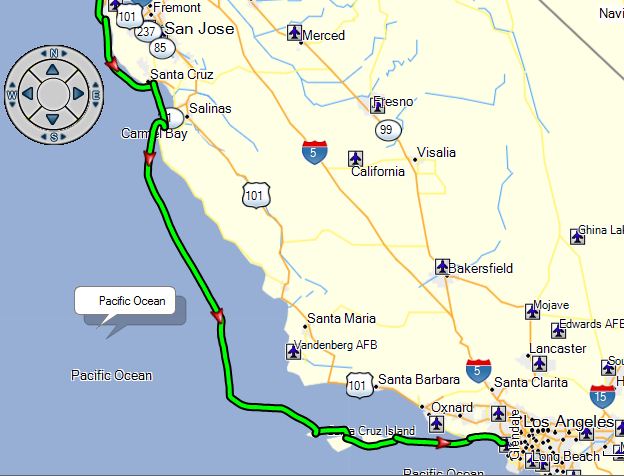
Our Route So Far

The route from San Francisco via Monterey and the Channel Islands to Los Angeles is below.  Next ports are Catalina Island, Dana Point, San Diego, and then we'll probably check in to Mexico at Ensenada.

Monday, October 17, 2011

At Marina del Rey, via the Channel Islands


Southern California bluebird days!  With lungs full of clean sea air and heads full of happy wanderlust, we entered frenetic but fun Los Angeles.  The only tragedy to mar this voyage so far is the cussed unwillingness of even one measly California fish to take Jim’s delicious lures, offered lovingly and temptingly.  We even have a herkin’ Coyote 6.0 lure, a gift from our B.C. friend Marty, who swears by it and who now (sensitively, thank you) types the phrase “I went f!$#ing” in his emails to spare us from having to endure reading the actual word.  These California f!$# need some serious lure rehab or something.  Perhaps a f!$#ing Swat Team.   A lobster boat off Malibu perfectly named “Bugs” couldn’t sell us any lobster (regulations prohibit that), but they gave Jim some mackerel for bait.  And, no, we did NOT have mackerel for supper.

Karen calls to Jim, fishing doggedly in the dinghy until dark: Are you using the Coyote 6.0 now?

No, he says, “I’m using Mackerel 1.0 and the fish still don’t like it.”

We realized then that there must be a sudden dislike sweeping local fish populations, for hooks baited with mackerel.  On the advice of a friend we let the lure sit on the bottom for a couple hours as we visited his boat.  Upon returning in the dark, Karen says, Oh yeah, better reel in the line or we’ll catch a ton of kelp again.  She grabs it.  Dang, too late, it’s heavy.  Wait a minute, this kelp is wiggling!  HEY! EVERYBODY WAKE UP!  We got a FISH!

Jim reels it in, a big one, as Karen smacks her lips and says Oh boy, halibut here we come!  But it was a 3-foot leopard shark.  Oh dear, how do you release one of these babies?  Verrry carefully.


But I digress; back to when we left Monterey for the Channel Islands, a few weeks ago.


Passage from Monterey:  We motor-sailed in light wind and no swell down the beautiful Big Sur coast that we’d just driven through—it was a sunny, clear day and Pacific white-sided dolphins played around the bow.  We took some footage and will post when we can get it processed.


Karen saw a lone, large, black-footed albatross and a (possible) juvenile Laysan albatross—is that possible?  It looked like one, it flew like one, but it was much smaller than the Laysans Karen has seen in the Aleutians.  Anyway, from 5 miles out at sea we raised a glass at sunset as we passed Nepenthe, where we'd dined and one of the finest restaurants anywhere.  Sunset was clear; perfect conditions for seeing the elusive Green Flash.


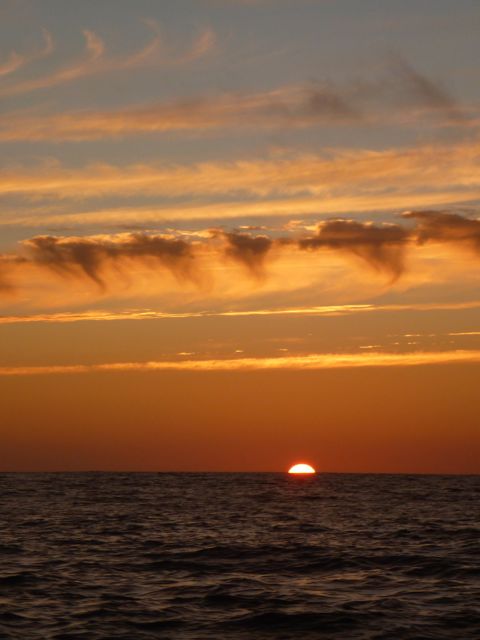
We watched the sun go down in a calm sea with gorgeous colors.  On rare occasions about half a second after it sets, there’s supposed to be, if you’re extremely lucky, a vivid flash of green right at the spot where the sun disappears.  We stared at the blazing orb… get ready… there it goes… OMIGOD!  I saw it! Did you SEE that?  We high-fived, because although it wasn’t a big Green Flash (more of a Green Speck, really) it was unmistakably green.  What a great portent for a 200-mile passage that turned out to be delightful.  Into a perfect starry night we went, and by 0345 were sailing under main and genoa in a gentle northwesterly.  In that 24 hour period we made 125 miles.


We’d decided to leave a day before the better winds arrived, because we wanted to make it all the way to the Channel Islands before the next storm system rolled in.  This meant some motoring early on, but ensured that we had decent weather at the end.  Here's a happy Jim, in need of either a barber or a double reef in his hair.  And that beard?  Hemingway-esque, eh?


A Gam at Sea:  Karen spotted a ship coming right at us.  We were on a collision course, so she called them.  The R/V Raven had been angling over our way to have a look at us.  Its captain just wanted to talk.  So there we were, yakking happily over the radio about shipboard research out of Dutch Harbor (Karen asked them if they knew the ship she used to sail on, the Tiglax, but they didn’t) and about the weather, and all sorts of subjects.  The captain fishes the boat in Alaska when he's not on contract to NOAA doing fisheries research.  We talked for 20 minutes, the big research ship and the little sailboat, having a nice sailor’s gam out at sea.  We asked where they were going, and the captain said after the next trawl they’d duck in to anchor under the lee of Point Conception.  We told them we were heading for Cuyler Harbor on San Miguel Island, and the captain said in all the years he’d been in this area he’d never been in there, because he thought it was too rocky to navigate.  After we discussed the entrance to the harbor with him and he had a good look at his chart, we bid them goodbye and sailed on.

Landfall:  The passage went so well that we arrived early at the crossing point between our course and the Santa Barbara Channel shipping lanes off Point Conception, which meant a we’d have night arrival at San Miguel, the wildest, rockiest and most northwesterly of the Channel Islands.  So here’s another unique challenge:  slowing the boat down in a rising wind so as to not arrive off a rock-strewn harbor entrance in darkness.   It’s not as easy as you might think.


We kept reducing sail until we had nothing but a tiny scrap of genoa out (there’s that meaty phrase again) and we were still doing 3 ½ knots when we needed to be doing 2.  Winds were 15-20 and forecast to increase, and Sockdolager did not want to slow down!   The seas were getting up, but we did some zig-zagging to increase the miles sailed and stretch out the hours until dawn.  It worked.

Around midnight just under the surface of a wave, Karen saw a squid, glowing ghostly green.  It was about two or three feet long, and aligned parallel with the waves.  It moved quickly and diagonally underneath one wavetop to the next wavetop, but always just under the water’s surface, pausing inside each wavetop, as if hiding under a mountain peak.  Squid are predators, and this behavior made us wonder:  does being inside a wavetop instead of in flat water increase the chances of being undetected by prey?  When the wind blows, is the change in sea surface texture actually a change in habitat that triggers different behaviors?  If any of our scientist friends have any thoughts on this, we’d love to know.  Here's a public domain photo that gives an idea of what it looked like:


Channel Islands idyll:  We passed San Miguel’s outer reef at daybreak and anchored by 0800 in a completely deserted, mostly treeless semicircular bay surrounded by low mountains, sand beaches, surf-washed rocky outcrops, and, surprisingly, a march of sand dunes right up a hill.  Around 10:00 the R/V Raven came in, anchored behind us, and we all waved.  You can just see Sockdolager in this photo:


The weather was going to get windier soon, so we dinghied ashore (our first surf landing) and went for a short hike before going back to the boat to rest and plan a longer hike for the next day.  The northern Channel Islands are mostly National Park lands.


But the winds rose to gale force and never allowed us to get ashore again for the entire 4 days we were there.  Williwaws roared down from the mountain ridge and blasted the boat at night, with wind gusts going from almost calm to 40 in a few seconds.  The swell curved into the harbor and we rolled a lot until we put out our flopper-stopper (a gift from Captain Peter Frost), which dampened the motion.  Big surf put an end to shore excursions.  But Cuyler was one of the most gorgeous, wild harbors we’ve seen since the Queen Charlotte Islands.  Amazing to have such a thing within 80 miles of Los Angeles.

We mentioned in a brief post made via our ham radio that the herd of elephant seals (who have large snouts and larger attitude) sounded like a stadium PA system commandeered by a gang of adolescent boys holding a belching contest.   You wouldn’t believe how far those low-frequency blubbering sounds carry.  These seals can get to 16 feet long, weigh six THOUSAND pounds, and can dive 600 feet to eat sharks.  Yeah.  Sharks.  In the marine world, these guys are the Incredible Hulks.  Here's a couple dozen lazing on the beach:


Here is a public domain photo closer-up.  These are smaller than the ones we saw, but we didn't want to get too close.


The largest males have a proboscis that looks like a short elephant's trunk.  We stayed a couple hundred yards away in the dinghy so as not to disturb the herd sunning on the beach, but several large males began to get up, stare and belch in our direction.  We then realized that the low burble of our tiny 2 horsepower outboard sounded EXACTLY like a six thousand pound elephant seal belching a challenge from out in the water.  Our inflatable dinghy being rather round, large and gray did not correct the impression we were giving them, either.  Uh-oh…  What was our outboard saying to them?

Outboard:  Hey!  Fatso!  Whatcha doin?  You call that a belch?

Extremely huge male elephant seal:  *Belch*  Don’t make me come out there, weirdo…

On the way back to the boat we stopped to say hi to the Raven’s crew, and they gave us some fish!  O!  Heaven!  We gorged on fish and chips for supper.

A small fishing boat came in, full of divers with hookah air hoses, and after a few dives they approached us and said YOU WANT SOME SEA URCHINS?  Whaaaa?  Karen replied, Um, we don’t know how to cook them, but then one of the divers shouted YOU DON’T; YOU EAT THEM RAW.  THESE ARE A TREAT IN JAPAN.  HERE, TAKE ONE!  And he cracked open the bottom of a big one and handed it over, a ten-inch pincushion dripping goo.  Um, THANKS, we said as they motored off.  Peering into the gooey black and red slime inside the urchin, we spied the yellow roe, which is what you’re supposed to spoon out and eat raw.

Karen looked at Jim.  Uh-unh. I don’t think so, he grimaced.  You’re on your own.

Very well then, she said, and spooned out some roe.  It tasted like… raw clams!  I can see why otters love these things, she said.  But the quivering Technicolor slime got the better of her appetite, so we slipped the bifurcated urchin back into the sea for other creatures to munch on.


Leaving San Miguel, we had a delightful 22-mile sail to Santa Rosa Island’s Becher Bay, an indent in its eastern side, but just as we rounded the corner into the channel nicknamed “Windy Lane,” the wind really piped up—to almost 40 knots!  The mainsail was already double-reefed, and with the staysail and a tiny scrap of genoa up forward, we sailed to windward at 4 ½ knots to stay in another rolly anchorage.

Jeez, said Karen, that was a lotta wind.

I want to complain to someone about this, said Jim.

Maybe we should compose a letter then, said Karen.

Dear Someone:
It has come to our attention that excessive winds of late have made for very rolly anchorages, and today’s 35-40 knots just as we were trying to sail into harbor and drop anchor was rather like gilding the weather lily, don’t you think?  In the future, we would appreciate it if you would refrain from doing that.
Sincerely,
The Sockdolagerians

Next morning we left, and in utterly calm water were delighted by the sight of several species interacting off the SW corner of Santa Cruz Island:  sea lions, white-sided dolphins, pelicans, gulls, and one or two other bird species.  The birds circled and landed in among the mixed group of sea lions and dolphins, and we watched as the sea lions executed perfect dolphin-dives right after the dolphins did.  They were so good at imitating dolphins that we did double-takes.  In other parts of the West Coast, sea lions don’t do this, but here in the Channel Islands, where they evidently play with or at least observe dolphins, they dive like them, even when the dolphins aren’t around.


Next stop was the nice large Smuggler’s Cove (above) on the east end of Santa Cruz Island.  We tried a couple of anchorages on the island’s south side, but with the large swell and the boats already crowded inside the tiny coves, we didn’t feel comfortable staying there.  Sharing the anchorage with other cruising boats is a pleasure, and we met several of their crews. Here's a view of the anchored boats from up the hill. Those trees are part of an olive grove.  Sockdolager is on the left:


Here's a view of Anacapa Island from the top of the hill.


The surf was pretty high, but we attempted a landing anyway and came close to flipping the dinghy.  Karen injured her foot on the cobble beach, so to keep the swelling down Jim got a nice cold pork roast and laid it over her aching foot.  It worked perfectly, and was delicious later as dinner.  This was an average wave, but many were much higher:


Sunsets are spectacular around here.  This is a view to the east from our cockpit as the sun set in the west.  That's Anacapa Island in the background.  It's one of the most important habitats for endangered nesting brown pelicans in the world.


We enjoyed swimming and snorkeling in the cold clear water, and Karen had a much-needed shampoo.


Hangin' with the stars at Malibu:  Our new Smuggler’s Cove friend Jim Morris, a solo sailor aboard the 46-foot ketch Silver Fog, had told us of a great anchorage at Malibu, called Paradise Cove, so we decided to try it.  As we sailed in, gawking at the mansions of movie stars on the bluffs overlooking the cove, we saw Silver Fog waiting there.  Anchoring was easy, but there was kelp all around.


While visiting with Jim Morris after sunset, we were surrounded suddenly by close to a dozen dolphins, all diving and huffing, but the most amazing part was that the water glowed where they swam, so that in the dark we could see them as ghostly greenish dolphin-shaped streaks!  It was a fabulous sight.  Here's Jim aboard his lovely boat:


Next morning he picked us up in his dinghy (much larger and faster than ours) for a run through the surf to go have breakfast at the famous Paradise Cove Beach Café, where popular TV shows like Sea Hunt and the Rockford Files were filmed.  Walking in, he commented, “You know, last night when I came in for a burger and gave them my credit card they saw my name is Morris and everyone suddenly went all ‘Yes sir, Mister Morris,’ and ‘How was your meal, Mister Morris, on me.  Dunno why.”  Then:  “Oh look, there’s Britney Spears!”

Karen, who was within ten feet of Britney, immediately looked the other way so as not to invade the privacy of a famous person trying to sunbathe practically naked on the beach, and thus cannot absolutely confirm that it was actually Britney.  But we’ll take his word for it.  Here are a couple more movie stars enjoying Paradise Cove:


In the café, where if you walk in wearing a decent pair of sunglasses everyone looks quickly to see if you’re someone famous (Karen did this and enjoyed it immensely), we were seated near an actress who’d been in the movie Charlie’s Angels, who looked just like a normal person with no makeup.  Our young waitress was rather inattentive, and Jim Morris whispered, “I think I’ll try something.” He turned to her and casually said, “I’m Jim Morris.”  It was like she’d been cattle-prodded.  She snapped to attention and was the picture of excellent service after that.  Suddenly, a large smiling man appeared at our table.

“I’m Bob Morris, the owner,” he said, “Do I know you?”

Jim Morris blanched under his tan, nearly blurted “DAD!” but held himself in check and explained who he was (just a sailor from that boat out there.)  Bob Morris was kind and funny, and gave us each a genuine Paradise Cove Beach Café Golden Sovereign coin!


Jim Heumann:  Wow, is this legal tender?

Bob:  Well, a guy broke a tooth on it.

Karen:  I see it’s made of 100% unobtanium.

Bob:  That’s right.  Not many people notice that.

We laughed, enjoying the whole joke, and ate a fabulous, heart-clogging breakfast.  Later, Jim Morris said he was sure Bob is an actor, too.  Saying goodbye to Silver Fog next morning, we headed for Marina del Rey.  After seeing the three hundredth (or so) huge beach mansion as we motored along Malibu in hazy calm, we came down with mansion fatigue.  Here's Point Dume, where the biggest mansions are and the anchorage we stayed in:


Life at Marina del Rey:  Our friend Bill Mooz, Grand Canyon River Guide Extraordinaire, picked us up shortly after we arrived, brought us to his home in Pacific Palisades, and pointed us straight at the showers (each to our own tiled and marbled bathroom).  Then he took us to dinner at a little Italian café, where he regaled us with stories of people he’s met and places he’s been.  He and Jim talked River Guide talk.  We all laughed long, often, and loud.  Then we stayed at his garden-secluded house and slept in a ROUND bed.  With a mirror overhead.  Yep.  That’s enough of those details.  But as host to a couple of tired and dirty cruising sailors, Bill gets our nomination for an Academy Award, a Grammy and a Pulitzer.

Jim, back at the boat:  You know, I think a mirror might be nice over the bunk…

This is Marina del Rey.  It's beyond huge.


Karen’s writer-friend Bill Neill, who lives nearby and is working on a maritime thriller called Rogues, roller-bladed over for a visit and we all spent the afternoon and evening talking about writing (huge fun for Karen), and what it’s like to work in television.  He’s been a writer and Executive Producer for a number of popular shows, including Unsolved Mysteries, and has written and edited more than 400 hours of TV script, so his stories were fascinating and fun to hear.   We can’t reveal anything about his upcoming book except to say that Sockdolager will be in it--Woot!

A character sketchy:  It’s 9:30 on a Sunday morning in Marina del Rey, largest marina in the world.  A twin-hulled, 40-foot cigarette boat with obscenely loud engines starts somewhere across the marina’s fleet of 8,000 boats.  We hear a VROOM!  VROOM! Ba-rumbarumba-cough-cough-VA-ROOOMMM! Ba-rumbarumba-cough-cough, etc.   These engines are so insanely loud that you can easily hear them five miles away at sea.  Anyway, the guy goes rumbling past our dock, so loud that of course everyone has to stop what they’re doing, say “What the…?” and go look, which is exactly what the lone occupant, a shirtless, deeply tanned middle-aged male, seems to expect.

He looks around to see who’s watching.  Then he turns and looks back at his shiny engine cowls, as if reassuring himself they’re still there.  Then, I swear, he looks down at his pants.  Then another scan of the dock; another look at the engines; a downward glance you-know-where. Dock, engines, pants.  Dock, engines, pants.  Everything’s still there.  Repeat until he gets to the fuel dock, where, because it’s full of boats, he VROOMs impatiently until there’s a space.  This started at 0930.  It’s after noon and he’s still parading throughout Marina del Rey’s length and breadth, treating everyone to the spectacle.  Eventually he launches himself into suborbital velocity outside the breakwater, and all is quiet again.  Later, a Bayliner goes sedately by with no fuss or rumbling, and I find myself actually appreciating Bayliners.  This is the only explanation I can possibly come up with for this kind of behavior:


An octopus, a squeeze and the National Enquirer:  We got acquainted with a nice couple on a sailboat docked next to us, and learned they’d sailed to French Polynesia on a 28-footer several decades ago “before GPS, I had to learn celestial on the way!”  And therein lies a tale…  some friends came to visit them in the tropics and brought a copy (of all things) of the National Enquirer, which they normally never bothered to read, but since they were news-starved in the boonies, Lydia devoured it cover to cover, noting with interest an article on performing the Heimlich maneuver in case someone chokes.  The NEXT DAY, and I swear we are not making this up, her husband, while eating calamari, choked on a tiny piece of octopus tentacle (“you know how it tapers, right, well it tapered perfectly down my gullet and closed off my breathing.”  Lydia thought, hey, didn’t I read about this in the National Enquirer yesterday?  She spun him around did the Heimlich maneuver, and Pop!  Out came the little tentacle!  “I saved his life!” she said.  Evidently word got back to the National Enquirer, and they featured a full page story on the Feldmans under a screaming red headline: “Couple Saved by National Enquirer Article!”   Closure on a story doesn’t get any better than this.

We loved this moonrise shot:


And finally...  We walked a mile or so to a ship's chandlery and Karen went to the front desk to ask if they had print-on-demand nautical charts of French Polynesia.  They didn't and steered her to someplace beyond walking distance.  Another customer overheard her and said, "We have charts all the way to New Zealand, would you be interested?"  The next day we met Tim and Debbie, two very experienced cruising sailors, at Starbucks where we bought all of their charts and most of their cruising guides!  Karen remarked to Tim, "This really was serendipitous!"  To which he replied, "It'll be this way for the rest of your life!"

Sunday, October 9, 2011

Still in the Channel Islands - 10/9/2011

After and four days of strong winds but mostly sunny skies we left San Miguel Island and sailed east to Santa Rosa Island. We had a lull in the wind in the morning but by the time we got to our anchorage it was blowing like crazy again. Next morning we decided to move on to Santa Cruz Island. This time there was very little wind so after sailing slowly for an hour or two we fired up the engine and motored along the south side of the island in blue skies and warm temps. Currently we're at Smuggler's Cove. I know it's autumn but this might have been our nicest day yet. It's clear we've arrived in Southern California.

The only negative so far is the the Pelicans are better fisherman than I am. They are diving into the water catching fish all around us and I haven't caught one yet!

We'll probably stay here for several more days before heading for Marina del Rey in Santa Monica.

This update sent via our ham radio.

Wednesday, October 5, 2011

At Anchor in the Channel Islands - 10/5/2011

After a nice 2-day passage from Monterey, we arrived here at uninhabited San Miguel, northernmost of the Channel Islands. It's one of the prettiest harbors we've seen so far, and we have it all to ourselves. Rode out some iffy weather last night and are waiting for it to clear. A large herd of enormous elephant seals on the beach sounds like a PA system that's been commandeered by a passel of twelve year-olds holding a belching contest. What wildness here, so close and yet so far from the huge cities nearby to the east. We'll roam the islands for awhile and then head for the mainland.