Here you will find tales of voyages past and present on our trusty Pacific Seacraft Dana 24, "Sockdolager," and our Bigfoot29 powerboat, "Raven," from Port Townsend, Washington, USA. In 2009 we sailed north from Puget Sound up the west coast of Vancouver Island to the Queen Charlotte Islands (now called Haida Gwaii.) In 2010 we went back to the west coast of Vancouver Island. In July 2011 we left the Northwest, sailed to Mexico, and in March 2012 we crossed the Pacific to French Polynesia, then on to the Cooks, Niue and Tonga. We spent several months in New Zealand, and in May 2013 loaded Sockdolager (and ourselves) on a container ship for San Francisco. In June and July 2013 we sailed north along the California, Oregon and Washington coasts, and in August we arrived home. In October 2016, Sockdolager found new owners, and we began cruising on Raven, a unique wooden 29' powerboat. In 2018 we cruised up to Glacier Bay, Alaska, and back. But in 2024 we had the chance to buy Sockdolager back (we missed her), so we sold Raven. We hope you enjoy reading about our adventures as much as we enjoy having them. (And there will be more.)


Tuesday, July 24, 2012

Tahiti to Bora Bora


We're in Bora Bora, nearly at the end of our visit in French Polynesia. Most of our time in FP was spent in the Marquesas.  We chose to see just one atoll in the Tuamotus (Fakarava), and felt quality over quantity was a good decision.

Finally, we sailed to the Society Islands group (Tahiti, Moorea, Raiatea, Bora Bora and more.)  Here’s where we were in Papeete harbor.


We wish we had more time to properly see the Iles Societies, but all in all, it’s been a terrific three months, which is the maximum amount of time the French allow Americans and Canadians to stay unless special, labor-intensive and very expensive arrangements for a long-stay visa are made before leaving the US.  I think it has something to do with a political fight on Capitol Hill years ago, over freedom fries. 


Although some of the street signs were a little weird (no one could tell us where to find the Culte of Silence because… it’s silent) we found the people of French Polynesia—all of them—to be polite, smiling easily and often, especially if you try to speak just a few words of their languages (French, Marquesan, Tuamotan, Tahitian.)  And who wouldn’t smile living in this lovely climate?


We finally rendezvoused with our Oregon-based friends Mark and Vickie of S/V Southern Cross, an Ericson 38, and spent an enjoyable day with them touring the island.  There are many things to do in Tahiti.  For example, you can swing on a vine.


You can drive (or hike) up the mountain to a gorgeous lookout over Papeete harbor  with Moorea in the background.  That’s Mark and Vickie with Jim.


You can visit Point Venus and see the lighthouse near the spot where Captains Cook and Bligh observed the transit of Venus.


There are some interesting ways of storing outrigger canoes there, too.


You can sunbathe on a black sand beach if you don’t mind the two-tone look afterward.


You can watch kids play near a waterfall.


And you can watch local fishermen bring in the pestilential crown-of-thorns starfish, which are both poisonous and invasive, causing great damage to reefs.  You can’t just chop them up and throw them back, or each piece could regenerate a whole animal; you have to dispose of them on land.  A recent article in the New York Times describes the perils that coral reefs around the world are facing. 


While we’re at it, here’s a shot of the damage that goats can do to an ecosystem—the fenced-in area where they live has been completely denuded of vegetation.


You can go to the market at 6:30 am to find bustling crowds.


You can talk to other cruisers—these guys own the only boat registered and berthed at Easter Island, and they were preparing to sail back there (to windward, yeeks.)


You can indulge in some Tahitian fast food; this man’s roadside drinking coconuts were tasty.


Or you can go to the Hieva Celebration, which is French Polynesia’s 130 year-old national singing and dancing competition.  When 200 tattooed, scantily clad dancers take the stage backed by a 40-member drum band with attitude, you know you’re not in Kansas anymore.  Photos weren’t allowed, but just google Hieva Tahiti images, and you’ll see what we mean.  It was a terrific way to spend an evening.  Made me want to do the hula and get tattooed.

You can also read about somber subjects, such as the 193 atomic bombs dropped over a 30-year period by the French on Moruroa and Fangataufa atolls, which does not even begin to count the horrific number of nuclear explosives dropped by the US and other nations on “remote” atolls that were actually peoples’ homes, throughout the Pacific, and about the continuing effects on marine and human health.  This is a memorial to all those places.


Mark and Vickie hauled their boat in Port Phaeton (below) a sheltered bay between Tahiti and Tahiti Iti, to be stored until they can return next year, to continue their voyage.  


We kept Sockdolager at the downtown docks in Papeete for almost two weeks. 

Photo by Karen Helmeyer

This was in part because the charms of a “big” city were irresistible, and part because of a windstorm that blew in and made us decide the docks were a better place to meet our Hawaiian friend Karen Helmeyer, who joined us for a week of sailing.


Jim nicknamed her K2.  The two Ks are best buds from an intensive course both took years ago at Harvard’s Kennedy School of Government.  When we meet other people and they say, “You’re both named Karen?  How convenient!”  we say, “Yeah, we’re sisters who were separated at birth.”

Sockdolager was med-moored in Papeete with her bow facing the dock, and we got ashore by walking on a tightrope from the bowsprit to the dock.  The minute you step on the tightrope it sags, which for a first-timer is not a welcome surprise.  But nobody took a bath.


Although quarters were a bit tight aboard the old Sockdolager, everyone coped with good humor and downright hilarity at times.  Besides being a fellow fracturer of English, French, Spanish and other languages, Karen2 also has the enviable quality of enjoying a cast-iron constitution, which means she never gets seasick—yippee!  Here she is in big seas, wearing her Florence of Arabia hat.


Fwactured Fwench:  Language was mercilessly butchered in our linguistic laff-off.  I wouldn’t know how to begin writing the mispronunciations of some French words we tried, but Jim takes the cake for his one-phrase-fits-all approach:

Clerk at grocery store:  Bonjour!

Jim:  Bonjour! 

Clerk, handing him change:  Merci!

Jim:  Bonjour!

Clerk, staring oddly at Jim:  Au revoir!

Jim:  Bonjour!

Karen2 marched up to a young clerk at a convenience store at the fuel dock and asked him in perfect French, “Do you need a hearing aid?”  Then she turned to another man and rattled off, “I have missed my train, and do not know what to do with myself!” It pretty much stopped all conversation, since there are no trains in Tahiti and everyone heard her perfectly.  Then the giggles began.  Berlitz phrase books contain the most useful phrases for gringo travelers!   

Breakfast cereal became Amuesli; a bruised knee to which no memory of the thwack could be summoned was declared a case of Amkneesia.  Any clothing worn to keep warm in is known as Snivel Gear. 

We made a few visits to our favorite waterfront brewpub, the 3 Brasseurs, which we immediately renamed the 3 Brassieres.  At another one called the Pink Coconut, a cruising couple from Beausoleil (the cookbook authors) hailed us while we were talking with a pair of friendly sailors named Larry and Nelda at another table.  Suddenly I realized that ALL the women who were about to introduce themselves to Larry and Nelda were named Karen. 

“Hi, I’m Karen.”
“I’m Karen, too.”
“Um, my name’s also Karen.  Seriously.”
“Wait.  THREE Karens?” said Larry.   
“Yeah, we run in packs.  It’s a Karen thing.”

Photo by Karen Helmeyer

Tahitian Rulottes are something you must try if the chance ever presents itself.  In the Army, as Karen2 (a retired Colonel) told us, these rolling restaurants would be called roach coaches or maggot wagons.  Yuck!  I’m such a civilian!  But they were clean, the smells were delicious, and my appetite returned.  Every evening at six about a dozen large vans roll into a Papeete waterfront park and begin cooking.  There’s Chinese cuisine six ways to Sunday, plus crepes wagons, pizza-mobiles, and one van offers a whole roasted mammalian species (either goat or veal) spread-eagled on a rack.  You walk up to the carcass, you order the cut, and they whack off a Neanderthal-sized chunk to your plate.  Whew.  I passed on that one, culinary wuss that I am.  We 3 loved the “Hong Kong” rulotte’s excellent Chinese food, and nearly died of ecstasy sharing a Nutella crepe at another rulotte.  Nutella crepes.  It’s what’s for dessert from now on.

Photo by Karen Helmeyer

Crossing an active airport runway is always a dicey thing, but crossing it in a slow-moving sailboat is extra exciting.  The short runway at Faaa airport (pronounced Fa-AH-ahh) ends abruptly at the edge of a narrow boat channel.  Here’s how to cross it:  

“Papeete Port Authority, this is the sailing vessel Sockdolager, requesting permission to cross the runway.”  Good god, did I just ask to cross an international airport runway in a sailboat?

“Sock… Sock… vhat is your boat’s name, please?”  (Heavy French accent.)

“This is Sockdologer (I’m giving it a French spin, saying something that sounds like “SuckdoloGHEARH.”  It works.)

“Ah, SuckdoloGHEARH, yes.  You may cross now, zhere are no planes landing for zhe next few meenoots.  Please call me back vhen you have crossed zhe runway.”

“Roger, sir, we will call you when we have crossed.”  If we don’t get sucked into a 747 engine, that is…

A brief stay at the anchorage at Maeva Beach/Taina gave us the chance to see our friend Shane aboard Clover again.  Here he is, with tattoos all freshened up by a Marquesan artist. He’s heading for American Samoa.  We also got an email from Craig on Luckness, and he’s making good progress from Hawaii to Seattle.  Zulu is either enroute or probably about to leave Hawaii for Seattle, too.  Who knows when we’ll all be reunited again?

Photo by Karen Helmeyer

We especially love this photo—Shane (in dinghy) versus the mega-yachts.  Our money’s on Shane.

Photo by Karen Helmeyer

Tahitian canoers love to “backdraft” on a boat’s wake, which helps them go faster with less effort.  Karen2 declared that she was ready to propose to this hottie.

Photo by Karen Helmeyer

The sail to Moorea started out calm, but ended with us double-reefing the main and genoa.  It was one of those Whoooeee-look-at-us-go! sails.  But Moorea, oh my.  One of the most lovely places on the planet.  And can K2 take good photos, or what?

Photo by Karen Helmeyer

Okay, folks, here it is, the official Tattooed Ladies Photo:


Did we really get tattooed, or are they just temporary?  Would we really do this?  Ya think?  C’mon, let’s have your opinions.

Dancing with the Stars:  The tattooing sessions were followed immediately by a hula session, in which the dancers pulled several people from the crowd, mostly types who don’t mind making fools of themselves.  Of course both Karens got up and made foolish fast.  Witness this photo of K2 photo-bombing herself:


And, a more sedate K1 does some vague hybrid of hula and monster mash.


Mega-Yacht Surprise:  We thought our brief stay at Cook’s Bay in Moorea couldn’t get any better, but it did:  one evening we went to dinner at a waterfront restaurant where a Scottish singer-sailor-autoharp-harmonica player named Ron was getting ready to entertain with oldies and folk tunes.  At the front desk a smiling woman named Arlene handed us menus, which would make anyone think she worked there, right?  She said we’d really enjoy the food and the music, so we stayed.  We liked Arlene and Ron right away.  Turns out she doesn’t work there, but was instead visiting Moorea aboard a 178-foot sailing yacht in the harbor, named Tamsen.  It quickly became obvious that she and Ron were madly in love.  A-HA!  The plot thickens! 

But magic was in the air for everyone that night.  Ron and Arlene joined us at our table for a few minutes of delightful talk, and the next thing we knew I was on stage with Ron, belting out “Summertime” without a nanosecond of rehearsal, and loving it.   Sometimes a song just slides out of you, almost singing itself—that’s how it felt.  The audience, about 40 of the 60 people aboard Tamsen, loved it too, and I got up several more times to sing and harmonize with Ron.   When I returned to our table, Jim and Karen2 told me that Bob, the owner of Tamsen had invited us aboard for a visit the next day. 

Here’s Tamsen in daylight and all lit up at night.  Her lines are quite graceful and the high level of maintenance is obvious.  Look up her web site here.  A nice writeup in the New York Times is here.  


If you’ve been following previous posts, you know that we’ve been rather critical of the behavior of some of the mega-yachts encountered along the way.  Most have been snooty.  Some have behaved badly.  This story will prove that every assumption has an exception, and what an exception this was.  Aboard Sockdolager, the 2 Karens dolled themselves up a little; then we 3 got into our tiny dinghy and motored grandly up to Tamsen, figuring we’d need to explain to the crew that “Bob” had invited us aboard, and then we’d wait like three gnats at the waterline until they fact-checked it.  Well we were in for a surprise.  There weren’t any crew in sight, it was all family and friends.  And Bob, his son Steve, and half a dozen other family members were waiting for us, waving!  We’ve seen 200-foot motor yachts that have 17 crew waiting hand and foot on just a couple of people, but we’ve never heard of a yacht this size being run almost entirely by a happy, noisy horde of 60 family members and friends, including mobs of kids.

The first thing that astonished us was not the magnificence of the yacht but the warmth and genuine pleasure every single person aboard Tamsen expressed at our visit.  Without exception each person greeted us and wanted to know more about us.  We were made to feel as welcome as family members.  Bob and Steve, along with several other family members, led us on a tour of the ship that was great fun (and so jaw-dropping I nearly needed a head-sling.) 

Karen2, by now the Official Sockdolager Staff Photographer, took some photos, so come along and we’ll take you with us.  Let’s start at the mainmast.  That’s Bob Firestone in the gray T-shirt, and the crowd around Jim and me are his family members and friends.  Everything on the ship was custom-built in Italy, from the steel hull with its aluminum superstructure to the rigging and interior cabinetry.    Bob’s son Steve Firestone serves as Captain, and he knows every inch of the vessel because he supervised its building.

Photo by Karen Helmeyer

Here’s a clean foredeck.

Photo by Karen Helmeyer

Just behind the foredeck are boat wells for each ship’s tender, but we observed that Sockdolager could probably fit in one of these without too much trouble.

Photo by Karen Helmeyer

Here’s a dinghy being lowered into one of the wells.

Photo by Karen Helmeyer

You want rigging?  BrionToss and Gordon Neilson, this photo’s for you.  Much of the running rigging is Spectra, which is far stronger than nylon or dacron, which means you can use a smaller diameter line; still, the genoa sheets were twice as thick as Sockdolager’s anchor rode.  Steve said, “It gets pretty scary on the side deck when this sheet whips around.” 

Photo by Karen Helmeyer

To gild the lily: another rigging shot, under the main boom, which houses the furled mainsail.  The boat’s working sail area is about 6000 square feet.  The mainsail weighs more than a thousand pounds.  Everything is mechanical:  the stresses are far too big for humans to raise or trim sails by hand. 

Photo by Karen Helmeyer

Here’s the control room for mechanical propulsion.  With its windows looking over the engine room, it reminded me of a recording studio.  Or the cockpit of the space shuttle (not that I know what one looks like).  Steve knows every inch of the engine room, too.

Photo by Karen Helmeyer

Here’s Karen2 at the helm in the wheelhouse, though the helm on a ship this size is actually a joy-stick and wheels are seldom used.


Left to right on the stern deck:  Karen Helmeyer, Bob Firestone, Karen Sullivan, Jim Heumann, and Steve Firestone.  Lin and Larry Pardey, this photo is for you:  Steve asked us if we knew you and we said yes; then he told us that he and his crew aboard the schooner Vltava once towed you through the Suez Canal!  The Tamsen crew is the same group of teenagers who sailed Vltava around the world in the ‘70s, and they asked us to send you a fond hello!


We were shown through every inch the interior of the ship, too.  Here’s the busy galley, where the kitchen watch-of-the-day was preparing a meal for 60. 
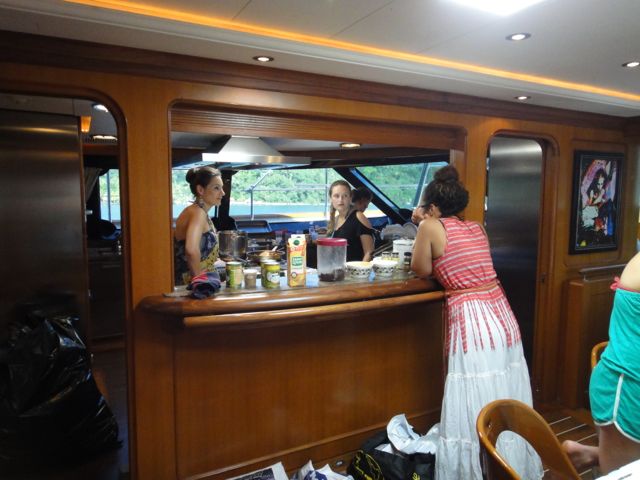
Photo by Karen Helmeyer

To give you an idea of how such a boisterous crowd is organized to run a ship, which is somewhat like running a small city, below is the Dock Watch List that Steve came up with.  There are 5 watches of 10-12 people each, with duties covering everything from a 24-hour anchor watch to cooking, cleaning, manning the swim platform, and running the tenders. 

Bob said, “We’re not what you’d call sedate.  When we pull into harbor, the other mega-yachts groan, oh no, not them again!”

“Are you saying,” I asked, “that when Tamsen drops anchor, it’s ‘There goes the neighborhood’?” 

“Absolutely,” said Bob, to guffaws.


We were amazed at the level of organization.  On major ocean passages they don’t take 60 people, of course—just a few sailing-savvy friends and family, along with their half-dozen permanent, paid crew, several of whom are lifelong employees.

Although it’s a big boat, there are not enough cabins aboard to give every married couple privacy in a party of 60, so they set aside a nice dark room nicknamed, if I recall correctly, the “consummation cabin.” It’s near the laundry room, and the adults book time in it.  Seriously.  There was much hilarity as one of the women opened the door and the young couple inside dived for cover. 

“Good grief!” I said, Does this door not lock?”  Desperately trying not to look like a voyeur, I shielded my eyes and backed away, but they said, no really, you should see this cabin! 

“If you don’t lock it someone will probably open it!” was the amused consensus.  I tried to apologize to the young couple for intruding at such a tender moment, but all the laughter drowned out the attempt.  Wowzer! 

Half an hour later as we toured the enormous main saloon, Bob told us the story of how, back in the ‘70s, he got a dozen families to partner and buy a 74-foot wooden staysail schooner, called Vltava, and let their 11 teenaged children sail it around the world by themselves.  It was Bob’s idea for forging stronger bonds of trust and confidence, in kids who otherwise might have taken a different track in life, and it worked beyond all expectations.  Steve was elected captain, even though at 16 he was not the oldest.  They made a documentary movie of the unusual Eastabout, 17-month circumnavigation, called “Voyage to Understanding,” and a couple dozen of us gathered to watch it on a big screen.  The family hadn’t seen it in awhile and decided it was time to view it again.  Those kids (and now their extended families) have stuck together ever since; in fact most were aboard that day.  In storied families with names that are household words, you don’t expect such warm welcomes, but aboard Tamsen, we felt like part of the family.  Here’s the happy crew of the smallest boat in the harbor leaving, with fondness, the largest.

Photo by Karen Helmeyer

Time to get going:  We sailed to Moorea’s Oponohu Bay to swim with and feed sting rays, but the wind was so strong it stirred up a chop that would have unbalanced us—and stepping on a sting ray is a very bad idea.  Reluctantly, we abandoned the effort.  But Oponohu Bay was gorgeous.  Here’s how we always enter a harbor these days, whenever there’s a pass to negotiate.

Photo by crew of Vulcan Spirit

I’ve always wanted to take this photo:


…because of this photo, which has been an inspiration since the ‘70s:


That’s the legendary Eric Hiscock on the fordeck of Wanderer IV, with the famous Tiger Tooth overlooking Robinson’s Cove ahead.  We dropped anchor in Robinson’s Cove and had it all to ourselves. 

Speaking of photo-bombing:  I forgot to mention that as the two Karens were dinghying across Cook’s Bay back to Sockdolager after visiting the craft fair again, another one of those disgusting giant flying cockroaches flew in and landed on, OMG, my NECK.  AAAA!   AAAA!  You never heard such a shriek.  I brushed it off and it landed on Karen2.  More AAAA!  AAAA!  With both of us shrieking and making wild arm motions and zigzagging with the outboard to elude the kamikaze cockroach, which continued to buzz us, we returned wild-eyed and breathless from our death-defying escape.  Jim was, as always, nonchalant.  There was no time for a photo, but I swear the danged thing was four inches long.


Okay, time to really get going:  We left Moorea for the 140-mile sail to Bora Bora, and made it in 31 hours.  The first 24 hours were windy.  Average speed was 4.7 knots, but we surfed frequently on the big swells, reaching 8+ knots regularly and twice more than 10 knots!  Not bad for a 21-foot waterline. 


Here, Karen1 plots the course on a paper chart, as backup to our electronic navigation.

Photo by Karen Helmeyer

Here’s Jim up in the rigging again as we enter Bora Bora’s pass.  Being up high is a good thing when coming through unfamiliar coral passes—even the wide ones.


Here’s the Bora Bora Yacht Club, where we are currently staying on a mooring. 


Where to next?  The piece of ocean between French Polynesia and Tonga is about 1400 miles wide, dotted with islands that have narrow passes or no passes.  It’s a challenge because of the weather (fronts coming up from New Zealand,) and the navigation; especially for its lack of large, easy-entrance harbors.  The Pardeys and others write of being hammered in “squash zones” there, so we are working with a voyage weather forecaster in New Zealand, who emails us weather information for a fee.  Our strategy is to try and cross it in several hops, none of which is more than 450 miles long. But if a harbor cannot be entered due to weather, we will continue on.  

The original plan was to head for Rarotonga in the Southern Cooks, but instead we’ve decided to go to an atoll about 180 miles north of it, called Aitutake.  Rarotonga has supposedly just finished a major harbor dredge and reconstruction, but the rumors about space availability are so confusing that we thought let’s stay further north in perhaps better weather, and go to an atoll, albeit with a difficult entrance, but one where we can’t be crowded out by large boats because its long channel has a 6-foot controlling depth. We draw 4 feet.  Here’s a view of that long coral entrance channel at Aitutake:


After that we might sail to uninhabited Beveridge Reef, to try some snorkeling, and then, to the tiny island of Niue, of which we’ve heard so much good about.  From Niue it’s only 250 miles to Tonga’s maze of islands, which we are looking forward to exploring.  But remember, the sea is changeable and sailors must adapt, so except for the goal of reaching Tonga, there’s no guarantee we’ll stick to this crossing plan.

As always, we’ll keep you posted as best we can, via blog updates by Ham radio, or the internet when it’s available.


Just as Jim paid for the bellyflop above, I just know I'll pay for the shot below, but what the heck.


Saturday, July 7, 2012

From the Tuamotus to Tahiti


Sockdolager in the gin-clear water near South Fakarava Pass (last week.)  That’s a coral head under the boat, and the water’s 15 feet deep!  Even though we’ve left Fakarava, we just had to lead off with this photo.


We’re now in Papeete, Tahiti, snug at the downtown dock.  We've been wrestling with the internet gods for two days trying to get this blog post published.  


Just for fun, here’s what navigating among big atolls looks like on our GPS. 

Wow!  Can you believe, after all that planning, all those cold Northwest winter days when we consulted the iPod’s cute little weather app that allowed us to say, “It’s 80 in Tahiti, Sweetie!” and after all that sailing, we made it!  Sockdolager is med-moored at Papeete’s downtown Quaie de Yachts, one of the most famous cruising crossroads of the Pacific.  Of course Tahiti, like anywhere else, has changed with the passing of decades, but still, what a thrill to be here (and it’s 82 degrees.)  The sight of crisp fresh colorful vegetables in the market, after all those limp carrots, compromised onions and antique cabbages, brought me to my knees.  While down there, the eye-level sight of a hand-lettered sign in a stall window that sold bacon and ham pizza and was labeled “Pizza Cannibale” brought me right back up from my knees.  These Polynesian madcaps.   Nyuk, nyuk.


To-ing and Fro-ing:  To catch you up on the doings of other boats we’ve previously reported on, Zulu (wooden gaff yawl) made it back to Hawaii in a fast, wet 18-day passage from Nuku Hiva.  Luckness (Pacific Seacraft Crealock 37) is still in Hawaii.  Both boats are planning to sail back to Seattle soon. Shane, our friend aboard Clover (wooden Lapworth 36), left Nuku Hiva on July 4th to head directly for Tahiti, where he should arrive around the 15th (and we’ll have a grand reunion.)  It seems Shane practically got adopted by a Nuku Hivan family, and we look forward to hearing his tattooed tales.  We’re very pleased to report that our friend John Pinto solo-sailed Aurelia, his Dana 24, from San Diego to Hawaii, in May (not his first time, either; he once made that trip with his wife Whitney and young son.)  He had a stormy passage, with gale-force and sometimes storm-force winds and very high seas, but as he told us in an email, he and the boat did just fine.  Big congratulations to John for raising $33,000 for the Hawaiian Eye Foundation!  Below is a sunset shot just for you, John.  Chris Humann, who sails the Dana 24 Carroll E out of San Francisco, is trying to organize a group of Dana 24s to do the Transpac race to Hawaii in 2014; heads up, Dana owners!    


Our friend Karen Helmeyer joins us from Hawaii on the 15th for a week of hangin’ with her homies before she heads off to go scuba diving in the Tuamotus.  Our itinerary will be determined over coffee each morning, but we expect will include Moorea, and maybe Raiatea and Bora Bora.


The passage from Fakarava atoll in the Tuamotus to Tahiti was 250 miles of the most mellow sailing we’ve had in a long time.   While the photo above is of sailing south inside Fakarava’s lagoon, the open ocean wasn’t much different from this glorious scene.  It wasn’t a fast passage, but when the weather’s this benign, who cares.  Bluebird days offshore outweighed the tension of a nighttime arrival at Tahiti, in heavy rain squalls that brought visibility down to zero.  Rather than go into downtown Papeete in darkness, we elected to creep slowly into the lee of lovely Point Venus and anchor where Captains Cook and Bligh once anchored to watch the Transit of Venus (the planet, which, along with Jupiter, is so bright in the early evening sky that we have mistaken it for a ship’s lights close up.)  Point Venus (pictured below) is a good spot to rest up before going into the big city. 


Let’s get back to where we left off with you on the Excellent Adventure, namely swimming with sharks.

Subscribing to the philosophy of seeing one place rather well instead of trying to see several quickly, we spent all of our Tuamotu time on the spectacular atoll of Fakarava.  Jeez, that sounds like a slick way of saying we suffer from a rather pronounced inertia problem.  Once we get to a place we like, we tend to hang out there rather than ping-pong all over the place.  It gives time to explore more thoroughly.


…and to take weird photos, like shadow-petroglyphs.


…and to walk on deserted beaches.


…or to just watch the coconuts sprout.


It also gives Jim time to try his hand at stuff like climbing a coconut tree (bad idea.)  “I could break my neck on this thing,” he said, from aloft.


Instead, he broke coconuts.  Sadly, none were edible.  Gringo luck, dude.


Our First Sharks:  Fakarava’s wide, current-swirled North Pass is a not-yet-famous dive spot, so we and another cruising family aboard a British boat named Streetcar signed on to go out to the pass on a local dive boat, snorkeling on the surface while the others went scuba diving.   The minute you slither off the boat and hit the water, you are in full-on, gasp-worthy coral reef paradise.  Not even Disney could make this up.  The shapes, colors and pure density of life on the reef enchant mere humans to awed silence.  Adequate word visuals?  Who has them?  Not me. 


Although we didn’t bring our cameras into the water, this is what the reef looked like.  (Photo courtesy of S/V Gato Go)

We glided around pointing at fish until I saw my first shark.  It gave me great pleasure to finally be able to yell “Sharrrrk!” and really mean it.  There were three, each about 4 to 5 feet long.  Of course, we knew in advance that these sleek black-tip gray reef sharks are supposedly curious and not aggressive under “normal” circumstances, whatever that means.  Locals say it’s time to get out of the water if the sharks begin to look excited.  Which begs the question, what does a bored shark look like?  Also, can we keep them calm while we’re visiting?   This should more accurately be phrased, can we keep ourselves calm?   According to a kind Tuamotan we met, sharks can actually sense your heartbeat and level of excitement (read: distress.)  I decided that perhaps this might not be the best time to belt out a gutsy version of “Mack the Knife.”  So, we watched with interest as the three sharks circled, then swam off.  Hooray!  We bored them!  Underwater photos in this post were kindly loaned by our friends Craig and Bruce aboard the catamaran Gato Go, and should give you an idea of what we saw, too.  We didn’t take our snapshot cameras in the water because, seriously, who could top their photos?  Many thanks to Craig and Bruce, whose blog we would link to if they had one.

(Photo courtesy of S/V Gato Go)

Then we followed a medium-sized hawksbill turtle that swam so calmly that the act of following it became a meditation.  The way it twirled its flippers to propel its tank-like self so gracefully—you don’t expect such grace from a turtle. 

How do you top that?  Suddenly we heard shouts—the boat operator pointed—dolphins!  Come back quick, he shouted, I’ll take you out to them!  We scrambled aboard, the boat went a quarter mile, we plunged back into the water, and again I was speechless—not just because of the sight, but also because of the sounds.  At least 2 dozen dolphins were all around us, some swimming deep at around 60 feet and some at the surface.  The water was full of their vocalizations—birdlike chirps, whistles and pings that I felt pass right through my body as they “sounded” us intruders.  Two of the dolphins were gray with typical bottlenose features, but the rest were a slightly smaller, light grey sharper-nosed species I didn’t recognize. 

Most of the dolphins were performing a kind of sexual water ballet, swimming close-packed and rubbing each other along their ventral sides, so engrossed in their own society that they hardly noticed us.   It felt good to see them go about their business with no alarm at our presence.  Then again, if I was a dolphin in the middle of a massage orgy, I’d ignore the humans, too.  The two larger Pacific white-sided dolphins stayed near the surface and were more curious than the others.  One had lots of tooth-mark scars, and I had the feeling that this pair was older than the other dolphins, who nonetheless swam around them as if they were all one tribe.  I can’t express how good it felt to be there.  To minimize any worries in their minds, I relaxed my body and made eye contact with the scarred one, giving it a small smile.  To my delight both swam over to within six feet, looking right at me, and stayed fairly close.  It felt peaceful, and I sensed they enjoyed the contact too.  For a first Fakarava snorkeling session, that was pretty hard to beat. 

There aren’t many restaurants around, but we enjoyed a rare dinner out on the beach, at the White Sands.


Anchor Rancor:  Rotoava, the village at Fakarava’s north end, is not a great harbor because boats are exposed to as much as a 30-mile fetch, plus anchoring in coral is a departure from the usual techniques.  For one thing, your anchor can damage live coral, so it’s best to pick places where there’s sand between coral heads, or, if that’s not possible, to anchor where other boats traditionally go.  In Rotoava’s anchorage the dead coral boulders are so dense that one can snag the anchor under a ledge (such fabulous brakes can make scope almost meaningless), but when the wind direction shifts, your chain can get wrapped around coral heads so much that a diver is needed to help retrieve the anchor.  Boats with all-chain who don’t pay attention can find that when the wind whips up seas that cause the bow to plunge, either the snubber or the chain, or sometimes both, can snap because all the chain’s shock-absorbing catenary is gone, tightly wrapped around coral.  It takes vigilance, which means daily dives in the water to check on the anchor.  (Oh darn, throw me in the water again.)  If you don’t have an all-chain anchor rode, it takes a little creativity, too. 

We don’t have all-chain because of the weight issue on a 24-foot boat.  Instead, we  use a combination of 65 feet of chain and 300 feet of mega-braid nylon rope for the main anchor, a 25-lb plow.  (We have four anchors and rodes in total.)  Two or three times the boat’s waterline length in chain is a pretty good starting point for making up one of these combination anchor rodes.  Jim can still pull the whole thing in by hand, which is one of the benefits of having a small boat (not to mention a strong guy), but we also have a hand-operated windlass for backup. 


The fender buoy is not over the anchor; it’s tied to the chain splice.  In this photo it's just visible ahead of the bow.  We’ve been asked about our “extremely short scope” by folks who thought it was an anchor buoy.

Oddly enough, this long-chain and rode system is called a Tahiti mooring.  The nylon rope rode acts beautifully as a snubber, and the whole shebang is easier and faster to retrieve than heavy all-chain.  The downside is the rope part can chafe through in twenty minutes if it gets caught on coral.  Jim experimented with ways to buoy up the rope section so it won’t chafe.   After consulting an informative, cruiser-written online guide called the Tuamotus Compendium, he came up with the arrangement, a “bouquet” of three boat fenders tied via a length of line to the splice between chain and rode.  It lifts the rope part off the bottom (and is adjustable) so that if we swing, only the chain wraps.  So far it has worked well, though Jim still dives on the anchor every day to prevent complex wraps.  He can free-dive to 30 feet, so we usually try to find that depth to anchor in.  Getting the anchor up in Rotoava still required some boat maneuvering and several alarming judders on the bowsprit as we brought the chain up short.  The best book on anchoring we've read is here. 


We were glad to move to another cove (Tona’e, about halfway down the atoll, pictured above) with lots of sand between coral heads.  A couple days there to wait for a fair wind, and we enjoyed a lovely run down the lagoon in perfectly flat seas, to Fakarava atoll’s renowned South Pass.  There is a marked channel going down the lagoon’s west side, and though reefs protrude into it, they’re fairly easy to see, almost neon-colored as in the photo below.  Definitely daylight-only affair.


The South Pass of Fakarava Atoll:  Fakarava is a UNESCO World Heritage Biosphere Reserve site, and deservedly so.  The water at the South Pass is gin-clear, allowing you to easily see the bottom at 40+ feet from the deck, and from in the water you can see at least a hundred feet.  We found a spot somewhat clear of coral in the anchorage, and went ashore by dinghy.  That in itself can be an adventure, as the current in the pass rips at 8 knots, more than most dinghy outboards can handle.  People have been swept out to sea.  Precautions are simple—don’t go on the maximum ebb tide in a low-powered boat.  A tiny, enclosed pocket beach on the side of the channel, with a small, perfect-for-kids cove called the Swimming Pool, is great for launching a swimming exploration of the reef beyond its edge. 

First observation:  sharks like shallow water!  Check out these photos, of sharks nearly grounding themselves.  They routinely swim in water so shallow that their dorsal fins cannot submerge.  The current runs fast through here, and it would be fairly easy to capture fish.


Yeah, we know:  And you went into the water with these guys?? 


Sockdolager had her very own remora (sharksucker,) about 2 ½  feet long, that stayed with us for nearly 2 weeks.  We named it Remy.  You can see the sucker disk on its head, for attaching itself to sharks (or boats.)  Remy adored Ritz crackers.


Second observation:  Fish are super-curious!  In the shallows, a five-foot Napoleon wrasse swam right up to us, also nearly grounding itself!   It did this so confidently that I began looking for vestigial legs.  Here’s the fish partly out of the water.


They’re comical and friendly, but still, it might be a bad idea to carry food because they also have noticeable teeth.  Probably half a dozen Napoleon wrasses about 60-80 pounds apiece live in the area, and they are a delight to watch as their funky, swiveling yellow and blue eyes give you the once-over.  Below is the same fish underwater.

(Photo courtesy of S/V Gato Go)

Third observation:  there are hundreds of sharks living here.  Between 450 and 500, to be inexact.  Most are 4 to 5 feet long, but some are larger—a friend saw a nine-footer while swimming, which unnerved her.  On the reef outside the Swimming Pool, we free-dived to 25-30 feet and saw a posse of probably a hundred sharks all milling around below us, at 60 feet.  Wow.  Here’s a photo of these sharks, taken during a scuba dive by Craig and Bruce. 

(Photo courtesy of S/V Gato Go)

At one point I looked down-current and saw FIVE sharks about 6 feet long swimming straight toward me.  At any other time or place in my life I would not have been so calm, but here, for some reason (perhaps the clear water, abundant food and habituation to people,) there is a tolerance on both sides that allows for some up-close interaction.  Or maybe we’re all delusional.  It reminded me of dozens of encounters with so-called “peaceful” salmon-sated huge brown (grizzly) bears at Alaska’s Katmai National Park. 

(Photo courtesy of S/V Gato Go)

Fourth observation:  There are more than a hundred species of fish here—an Australian research team confirmed this on a few 50-meter transects.  Every time we went underwater, we saw something we hadn’t seen before, especially in fish design, color and behavior.  One fish dug a big hole while we watched, roiling sand with its fins and nose and shooting sand out of its gills.  Another species has a horn coming out of its forehead, like a unicorn, while another has a horn on its lower jaw.  Yet others munch on coral much as you’d take a bite from an apple and spit out the seeds.  There’s an argyle-patterned one, and another only Picasso could have painted.  Fish designs from this reef would be the utter envy of the biggest, baddest hot-rod pin stripe shop.  Their wild colors, spots and stripes were the most entrancing feature of all.  This fish is called a Humuhumunukunukuapuaa.

(Photo courtesy of S/V Gato Go)

How to Fly:  The activity most people find addicting is “drift” diving or snorkeling.  Here’s how it’s done.  At slack low tide, take the dinghy with all your snorkel or scuba gear out to a buoy near the seaward end of the pass, and tie to the buoy while you don your gear.   Toss the dinghy painter (its tie-up rope) into the water, along with a rope tether for each person, and let the current sweep you back along the reef into the atoll, while hanging on to the dinghy line for safety.  It takes about an hour, and is the closest thing to flying we’ll ever feel. 

(Photo courtesy of S/V Gato Go)

At one point the current really rips and you’re flying over the bottom at 5 knots.  Jim and I spotted a piece of rebar sticking out of the reef to mark a shallow spot.  We swam over and grabbed it to see what would happen.  The current flagged our bodies and nearly ripped our masks off!  We let go and were able to ride the current all the way back to Sockdolager at anchor.  We couldn’t get enough of this thrill.  I (Karen) am certified to scuba dive, but didn’t feel the need to do it because snorkeling was so spectacular.

(Photo courtesy of S/V Gato Go)

For a little break from all this eco-porn, how about some culinary porn—a shot of homemade English muffins.  Bread’s almost impossible to get in a lot of places, so you have to make your own.  We tested them on a genuine English couple, Richard and Allison from Vulcan Spirit (Halberg-Rassey 53.)  They liked them so much we had to cough up the secret recipe, and then they served them to us along with cream scones, for which of course we made them give up that recipe.


Here’s Allison on the bow of Vulcan Spirit, thinking about having another English muffin. 


We’ve decided that if, in our dotage when we’re too feeble to sail but want to come back to the South Pacific for a Fakarava South Pass drift-dive reprise, we’ll stay at Manihi’s gorgeous lodge and eat fish pizza with cruising boats until we drop.


We also enjoyed the company of brothers Nick and Alex, their dad Tad, and Sarah Rose, a journalist on assignment from Outside magazine, all aboard Saltbreaker, a Valiant 32 out of San Francisco.   At one point the crews from all of the cruising boats in the anchorage were drift-snorkeling together like one big party.  Pizza evenings at Manihi’s topped off good days.

Biophilia and Behavior:  The eminent ecologist Edward O. Wilson coined the term “Biophilia,” to describe the innate attraction that human beings have to wild places and wild things.  One of the results of this phenomenon would hopefully be respectful behavior, but it doesn’t always happen.

(Photo courtesy of S/V Gato Go)

Two good dive operations are located at the South Pass.  We got to know Laurent, an expatriate Frenchman with a New Zealand accent, who operates one of them.  He sees dozens of boats come through.  Most are good citizens in responsible ecological behavior, but a few bad apples visit, too.  “There’s no enforcement attached to this UNESCO designation,” he lamented, “People can do what they want here, and there are no consequences.”  He described how some fishermen came in from the north and shot the largest Napoleon wrasse of all, named Josephine, just because they could.  This shocked us, because we thought the big wrasse we’d seen was Josephine.  Oh no, he said, Josephine was much larger; the size of a car door. 


“I wish there were consequences for this kind of behavior,” he said, pointing at a 200-foot mega-yacht whose six tenders, including two forty-foot fishing and water-ski boats, plus four jet skis, were all busy zooming at high speed over a full square mile of the lagoon.  “The owner of that mega-yacht (supposedly a Las Vegas casino billionaire, who probably just chartered it; the boat's web site lists the cost at $525,000 US per week) ran his jet ski right up onto the coral yesterday.  He backed off, then kept going.  You’re not supposed to run jet skis in here, but the big yachts all do it.”  Laurent felt helpless and upset.

Surgeonfish shared the underside of our boat with Remy the remora.

“Designations like World Heritage Sites don’t usually come with enforcement, which would require the home country to enact legislation and a budget,” I said. “Instead, they’re designed to let everyone know, like blue ribbons on the wall, what special places these are.  And even though lots of them are threatened, they’re still a foundation for building future regulation.  Without regulation, enforcement has to be in the form of pressure from the people who feel stewardship for these places taking the initiative, and talking to offenders to convince them to stop certain behaviors.”

“But who’s going to drive their tiny dinghy up to a mega-yacht to tell them that?” he replied.  He did have a point.


Above: A future fossil on a raised reef.  Below:  the same animals, alive.  These are Tridacna (giant) clams, and they have colorful sensitive eyespots, hundreds of them.  


“I think the mega-yachts might respond to locals better than to other cruising boats,” I said, remembering a mega-yacht at the North Pass the week before.  It bought up all the fresh vegetables in town the night before the weekly market, leaving none for the fifteen cruising boats in the anchorage.  I don’t know if the locals were able to get any vegetables, either.  Sadly, this is not an uncommon occurrence.   The market opens, people try to buy vegetables, and they hear “Sorry, they’re all sold.”  Although I do not mean to lay all the blame for selfish behavior on mega-yachts, there is a fundamental wrong at work when such things happen. 

“I sure wouldn’t be comfortable dinghying up to them,” said Laurent.  “But someone has to.  In a few years this place won’t look like it does now.  Last week a boat dropped anchor in the middle of the pass, right on top of live coral.  You’re not supposed to do that.”

(Photo courtesy of S/V Gato Go)

As we left Fakarava via the South Pass a few days later, a large French catamaran had just dropped anchor, in the middle of the Pass, on top of live coral.  The owner waved, took a drag on his cigarette, and tossed the butt into the water.

I think, that with 20 percent of the planet’s coral reefs already dead and at least 50 percent of the remaining ones dying or imperiled, we must either do whatever it takes to protect them soon, or we’ll lose them. 


Med-Moored at Papeete’s Cruising Crossroads:  Back in Papeete at the downtown dock, there are boats here from Sweden, Germany, Poland, Australia, Canada, USA, England, France, Austria, Italy, and those are just the ones we’ve met!  Tahiti is full of long-distance cruising boats. 


One change that’s happened here, which might interest other cruisers, is that boats no longer drop anchor to med-moor along the very long sea wall, which adjoins a large park.  Instead, a chain of floating pontoon docks (rather like small barges) has been installed perpendicular to the seawall, and you moor to these.  One dock is for cruisers and the two others are for local charter boats.  There’s a separate dock for mega-yachts nearby.  Instead of dropping your own anchor you pick up a hefty but slimy mooring line that’s been provided.  In some ways it’s better, because we’re further from the traffic on Boulevard Pomare, there’s no more risk to anchors getting tangled on the bottom, it’s easier to come and go, you can face the boat into the wind, there’s unlimited fresh water, you don’t get hordes of passersby looking down into your boat if you’re stern-tied, and there is a security gate at the head of the dock (boats have been robbed in recent years.)  But it does demarcate a separation between yachts and local people, something we have mixed feelings about.  In the days when cruising boats were smaller and simpler, friendly interaction might have been more frequent and more welcome.  BTW, the leap from our bowsprit to the dock would please a monkey.

But the local people now have their park back, with open lawn, a seawall strolling path and an unobstructed view.  They’re setting up stages for the Hieva celebration, which will include a Polynesian version of Battle of the Bands. Tomorrow a huge canoe race starts from the sea wall just behind us.  Hooray!

Dock space is at a premium.  With more big catamarans taking up double-widths and the floating dock’s linear space being significantly less than the original seawall’s, you might find no vacancy here at busy times.   Overflow traffic can still side-tie to the concrete seawall, but with the enormous surge from the wake of the ferry Aremita, we wouldn’t want to.  It’s also no longer free like the old seawall days—there’s a complicated formula to figure out your daily charges, which start at about a dollar a foot per day.  Oh well, time marches on and there’s plenty of fresh water, not to mention an honest-to-goodness brewpub nearby.   Whooie!  We’ll stay here for a few more days (in spite of the bustle and expense we are lovin’ it) and then will move to the anchorage at Maeva Beach.

Ironically, we had to drop an anchor when we arrived because all the big mooring lines were in use, with some boats using two lines.  But soon a pre-set line became available, and we retrieved our anchor, glad to not have it snag on the bottom.   I look at the now-empty curving sea wall directly astern of us with nostalgia, because it’s easy to conjure up the ghostly shapes of Wanderer III, Islander, Joshua, Tzu Hang, Seraffyn and others who’ve moored here. 

In his book The Tao of Travel, author Paul Theroux calls Tahiti a “…mildewed island of surly colonials, exasperated French soldiers, and indignant natives, with overpriced hotels, one of the world’s worst traffic problems, and undrinkable water.”  Perhaps this was so for him, but traveling by sailboat, we have so far found unflagging friendliness from locals, including Native Tahitians, French residents, gendarmes and Port officials.  We can drink the water right from the hose it’s so good, and if we take a single step onto the busy Boulevard at one of the many pedestrian crossings, traffic comes to a polite, firm halt, even during rush hour.  The hotels we don’t know about, and some food items are ridiculously expensive.  Others are ridiculously cheap.  I think I could live on baguettes, Brie and Bordeaux.  And duck.  Which brings up our last story for this installment…

The Duck That Lit the Dock:  While Jim explored the chandleries, I walked to the market to get groceries, hoping to find some fresh chicken.  Grocery shopping in foreign countries is a certifiable form of entertainment.  There were some nice looking small local whole chickens for roasting.  A-HA! I thought, perfect.  I picked one up.  It was very small, maybe two pounds.  It dropped like a rock when I saw the price: nearly $18!  For a frickin' chicken?  


Never mind, let’s see what else there is.  In the corner of a long freezer was the duck section.  You have to remember that duck is big to the French.  Very, very big.  And subsidized.  Frozen duck quarters—individually shrink-wrapped, partially cooked, and seasoned with foie gras and herbes de provence. Price, about three bucks.  WHAT??  Three buck ducks?  I bought two, and as I returned to Sockdolager one of the other boats announced they were all having a barbecue for the 4th of July and would we like to join them?  Oh yes, I said, but I just bought Cuisse de Canard instead of hot dogs, is that alright or is it too un-American?  Oh, no problem, just throw ‘em on the barbie, someone said.  Which we did. 


The first barbecue, which was providentially fastened over the water next to a water hose, went up in flames; brilliant shooting fire licks a couple feet high, shooting through the holes, under the lid, and all around it, crackling like Hellzapoppin’.  Jim jumped back like a lion-tamer.  Yeeks!  A cruiser who knows about duck asked, did you render the fat?  Huh?  Render the fat?  Uh-oh, we said, it may be rendering unto Caesar as we speak.  The owner of the first barbecue came over and said, Jeez, maybe mine’s too hot, why don’t you try this barbecue, which is running a little cooler?  It belonged to another cruiser.  Okay, we said, and we rendered unto Barbecue Number Two, our duck. In the photo below there is no artificial light.  It's all duck.


Before long a professional firefighter aboard a nearby Australian boat was having trouble not running over and throwing the whole thing in the water.  Flames shot in every direction, grease ran onto the dock, and under the black 4th of July sky we needed no stinkin’ fireworks.  The Duck That Lit the Dock was gloriously immolating itself and also making the preparation of good ole American hot dogs and hamburgers in any condition less than well done a bit, uh, shall we say, pyrrhic.  The table pictured below contained non-flammable foods.


Finally, we plucked our luckless duck from the flames, chucked water on the barbecue, apologized profusely for all the greasy dock guck, thwacked the duck into a crock aboard our boat, and cooked the charred little suckers.  Because we’d made such an impression on everyone (we’re f***ed, we thought), I offered bites of my duck leg all around. Several cruisers tried a piece and loved it.  They said oh my god that’s good, where did you get it?  I think we may be moving our boats a little further away from the dock tonight.


Saturday, June 30, 2012

On the Way to Tahiti

We left Fakarava yesterday (June 29) afternoon and are now in route to Tahiti with 110 miles left to go. Then it's the big city of Papeete (135,000) where we will have an internet connection for a longer post and photos. And I hear rumors of dark beer...

Wednesday, June 27, 2012

Alive and Well in Fakarava

We are having so much fun here at the south pass of Fakarava that we seem to be having a hard time updating the blog. Or maybe swimming with sharks, lots of sharks, somehow affects the ability to write. Not to mention dolphins, turtles and the most amazing fish we have ever seen. And now we have to go get pizza with five or six other cruising boats. More to come.