
 Posts
Posts




Someone said to us recently, “You are going to remember that
long straight wake with great fondness when you’re bashing uphill from San
Francisco.” Hoo boy, were they ever
right! Sockdolager is safe but remains weathered
into Coos Bay, Oregon, and the latest forecast says we may be here awhile
longer than we thought. All but the
largest fishing boats are harbor-bound.
But you, good reader, were left stranded in this 4-part
photo-saga, just before our container ship, the M/V Hugo Schulte, made an
early-morning landfall at Ensenada, Mexico in early June. Time to finish the story.
The Mexican pilot boat came alongside, and two pilots
boarded. You can see one of them
clinging to the rope Jacob’s ladder, just before stepping onto the
gangway. They were pretty winded by the
time they’d climbed all that plus seven flights of stairs to the wheelhouse.

Ensenada is not a big harbor, and two tugs awaited us at the
entrance.

They maneuvered us toward the wharf.

The pilot explained the docking procedure to the
ever-watchful Captain Zoran Mufa. This
is the first time the Hugo Schulte has visited Ensenada. All went smoothly.

With 300 Mexican pesos burning a hole in our pockets, we set
out for a 2 ½ hour excursion town. Captain Zoran looked at us with concern and said,
“Please be back on time.” We knew the
ship would not be able to wait for us, and assured him that we would. Down the gangway we 3 went (Passenger Barbara
was with us.)

We were met by an
escort van, which made us feel like VIPs but whose main purpose was to keep us
from getting run over by giant wheeled machines, and went to the gate, passing
through two checkpoints where our identities were affirmed and matched against
a list. Besides being good security
procedure, it helps keep stowaways off the ship. We did not realize what a problem stowaways
are until we saw all lower hatches, ports, and entrances except the main one
being locked, and guards stationed at the base and top of the gangway. It’s not such a problem in North America as
it is in Asia, but wow anyway!
 |
| Ensenada Mexico's giant welcoming flag |
A taxi took us into town.
Very little was open at that hour, so we wandered around reminiscing
about the last time we were here, in our first foreign port, and went to a
grocery store to buy some of our favorite Mexican foods. Barbara went off to explore on her own and we
arranged to meet her at ten o’clock at a cantina we’d selected, to find a taxi
back to the ship.

Oh, the heaven! Tacos
dorados and a bean burrito for breakfast!
And coffee and Mexican hot chocolate, because they don’t serve or sell
Margaritas or any liquor before ten.
Margaritas at that hour would have made us look (and feel) a little too
hard-core, anyway. We got snippets of
Mexican news from a big-screen television.
News anchors are the same, it seems, all over the world, as are
celebrity gossip shows. Of all the
things we’ve missed, TV isn’t one of them.

Back aboard the ship in plenty of time for departure, we
watched expert helmsman Benito steer the ship with a tiny wheel. Gotta have a look at the steering mechanism
down below, thought Jim. Chief Engineer
Laurentiu obliged, and another amazing hour was spent deep inside the inner
workings of the ship. I have been
misspelling Lautentiu’s name in prior posts.
We still call him Lawrence, but Laurentiu is how it’s spelled in
Romania. He gave us a great tour. That bronze-topped cylinder in the middle is
the rudderpost, operated by two powerful hydraulic pumps that move it according
to commands from either the wheelhouse or the engine room, depending on what
the Captain wants.

Here’s a closer look at the heart of it, a mechanical
delight. Two hydraulic rods, one on each
side, push the notched housing side to side across a greased bearing. The bronze strip that looks like a ruler
visually gives the number of degrees of helm.

Here’s Laurentiu, who, along with the Captain, was a fine
dinner companion as well as a great Chief Engineer throughout the voyage.

But the tour wasn’t finished! Laurentiu showed us the space between the
inner hull and the outer hull, and we were amazed at how big it is. Watertight bulkheads secure it at all times,
so that if a portion is breached, the ship can still operate. Double hulls have been a requirement on ships
for decades. Though they can’t prevent a
hull breach in severe circumstances, they can minimize the number of sinkings
and amount of oil leakage in some accidents and groundings.

Soon we were back in American waters.

The last day of our 19 at sea was spent mostly on deck,
enjoying the ride off the waters of Southern California.

At 4:00 am on June 6 we went under the Golden Gate Bridge,
and what a beeeyootiful sight it was.

We passed between Angel Island and Alcatraz in the light of false dawn, then as the sun rose we approached the Oakland terminal with our
escort of tugs.

After bidding our new friends a sad adieu, we boarded an
escort van for the terminal exit.

Then it was time to bid a happy hello to our friends and
fellow Dana 24 owners, Chris Humann and Laurence Boag. We piled aboard Laurence’s exquisitely
maintained Dana 24, Graceful Exit.

With Chris, Jim and Karen on the boat and Laurence in his
zippy new Zodiac dinghy, we made the 6-mile trek from Alameda out to the far
side of the terminal, to await the unloading of Sockdolager at around two
o’clock.
 |
| Laurence Boag, Chris Humann, and Jim Heumann. Chris and Jim aren't related except by boat. |
Especially prominent on Laurence’s Dana 24 was this cute
little number he’d fished out of the water, now gracing the bow. When guys back in the olden days coined the
word “figurehead,” I’ll bet nobody ever visualized one like this:
 |
| Hubba Hubba! Barbie on the bow alert! |
We arrived on the scene, a small recreational sailboat
amidst a welter of tugs, barges, ships and other commercial boats.
 |
One guy on a commercial ferry came over to politely inquire
if perhaps we might not find other waters more enticing to sail in, but when we
told him why we were there, he backed off and waved nicely.
 |
| Hugo Schulte alongside the wharf with a fuel barge |
Agent woes: For this section, it’s important to know that
once a container ship arrives in Oakland, union rules prevent her crew from
doing any work related to unloading cargo.
It’s all done by stevedores, and they do it their own way. The ship’s crew has no say in the matter.
The agent we had hired for the US side of the shipping
journey had been difficult to contact and unresponsive for the entire time we
tried to work with him, starting in New Zealand. For several weeks before we left NZ, Jim
emailed and called this Newport, Rhode Island-based agent multiple times,
leaving messages asking what we should expect when we arrived in Oakland, but
he was utterly unresponsive. For almost
the entire voyage across the Pacific, Jim emailed him from the ship, asking for
a simple reply, but none came. We had given Chris Humann the agent's name and number, and he managed to make a few calls on our behalf. The incompleteness of the details added stress, because although we had a basic idea of what would happen during the offloading, we had conflicting times for when Sockdolager would be lifted out of the hold. This was in stark contrast to the step-by-step,
exceptional service from our New Zealand-based agent, Richard Thorpe. And it’s how we ended up making our own
arrangements for a “tow boat,” with the generous assistance of Laurence and
Chris, to meet us and take us to the ship.
Richard had intervened on our behalf during the voyage and also on the day
before we arrived at Oakland. All Chris got
from the US-based agent was another phone number for a local contact, a sub-agent who gave him a few sketchy details. An
hour before the offloading began, this sub-agent finally called Jim to say what they were
planning to do.

Coming from a foreign
port, we didn’t have a US phone, which we had originally mentioned to the US agent
as a good reason for trying to nail down everything in advance. We had to borrow Chris and Laurence’s phones. Although I won’t mention the Newport, RI-based
agent’s name, the firm he works for is called
“Masterpiece International.” The
agent made it quite clear to us that we were not remotely close to being a
priority. The extra stress he caused in an already stressful situation was completely unnecessary, especially
considering the handsome fee he charged.
 |
| Sockdolager emerges from the ship. Photo by Laurence Boag |
Adventures in gravity: We had been led to expect that as with almost
all boat offloadings, a crane would pick up the boat from its cradle and flat
rack using straps. We had carefully
placed obvious marks on the hull for where the straps should go. But the US agent and the Oakland stevedores
had other ideas. First, all but 4 of the
16 expensive blue tiedown straps we’d purchased for almost a thousand dollars
were either slashed or stolen.
Sockdolager sat loose in her steel cradle, and instead of using crane straps,
the stevedores shackled their four lifting lines directly to the tiedown rings
that had been welded onto the base of the cradle. Back in NZ when I’d called them “lifting
rings,” the skilled welder who made the cradle told me that under no
circumstances were they to be used for lifting the boat; they were for tiedowns
only. Thank goodness he overbuilt that
cradle. So okay, here comes Sockdolager,
loose in her cradle, lifted on the strength of the 4 tiedown rings. Heart-in-your-mouth time.

She was lowered into the water without incident, and with
huge relief we climbed aboard as the crane held her in place on the cradle. Many of
the Hugo Schulte’s crew were standing on the side deck watching and cheering,
and Captain Zoran gave a nice long blast on the ship’s horn. We whooped with delight! Jim struggled with the combination lock, whose dial was corroded and nearly unreadable. He finally opened it, reached inside for the ignition key, handed it to me, and that’s when we discovered Sockdolager’s
batteries were completely dead.

The tiny
draw from LED displays, combined with 19 days in a dark hold, had drained
them. Jim hadn’t disconnected the
battery because he’d assumed that some sunlight would reach Sockdolager in her "protected stow" area, plus ours are superb batteries that keep a charge
well. But the boat ended up too deep in
a hold for any sunlight to reach her, and the batteries were so flat that the
solar panel charger could not detect any current and would not work until we
later hooked up a battery charger.
“We need a tow!” we shouted to Laurence as he circled in the
dinghy. After several tries in a rising
chop on the windward side of the Oakland Terminal, we had a towline between
Sockdolager and the dinghy ready, and I signaled to the crane operator to lower
the cradle, fast, so we could get away from it. But he didn’t. He only lowered it a little. Sockdolager was slammed around by the chop, still inside her
cradle, with the crane's greasy cables chewing up a bit of her rail and the tops of each steel side piece on the cradle
gouging into her shiny green hull. None of this would have happened if our US agent had directed the stevedores to use lifting straps, as they should have. I
yelled and gestured to drop the cradle lower, and Chief Engineer Laurentiu, who
sized up what was happening from his position on deck, intervened and gave the correct signal to the
crane operator. Finally, Laurence Boag in his dinghy pulled us out of harm’s way. Whew.
Now, in the chop, we had some difficulty getting the
dinghy to tow us further out to safety and to Graceful Exit, which was hovering with Chris at the helm. Finally we reached her and made two lines fast to
the stern of Graceful Exit, which then towed us the six miles back to
Alameda. Double whew.

Laurence and Chris, we owe you a debt of gratitude. This could not have been done without your help.
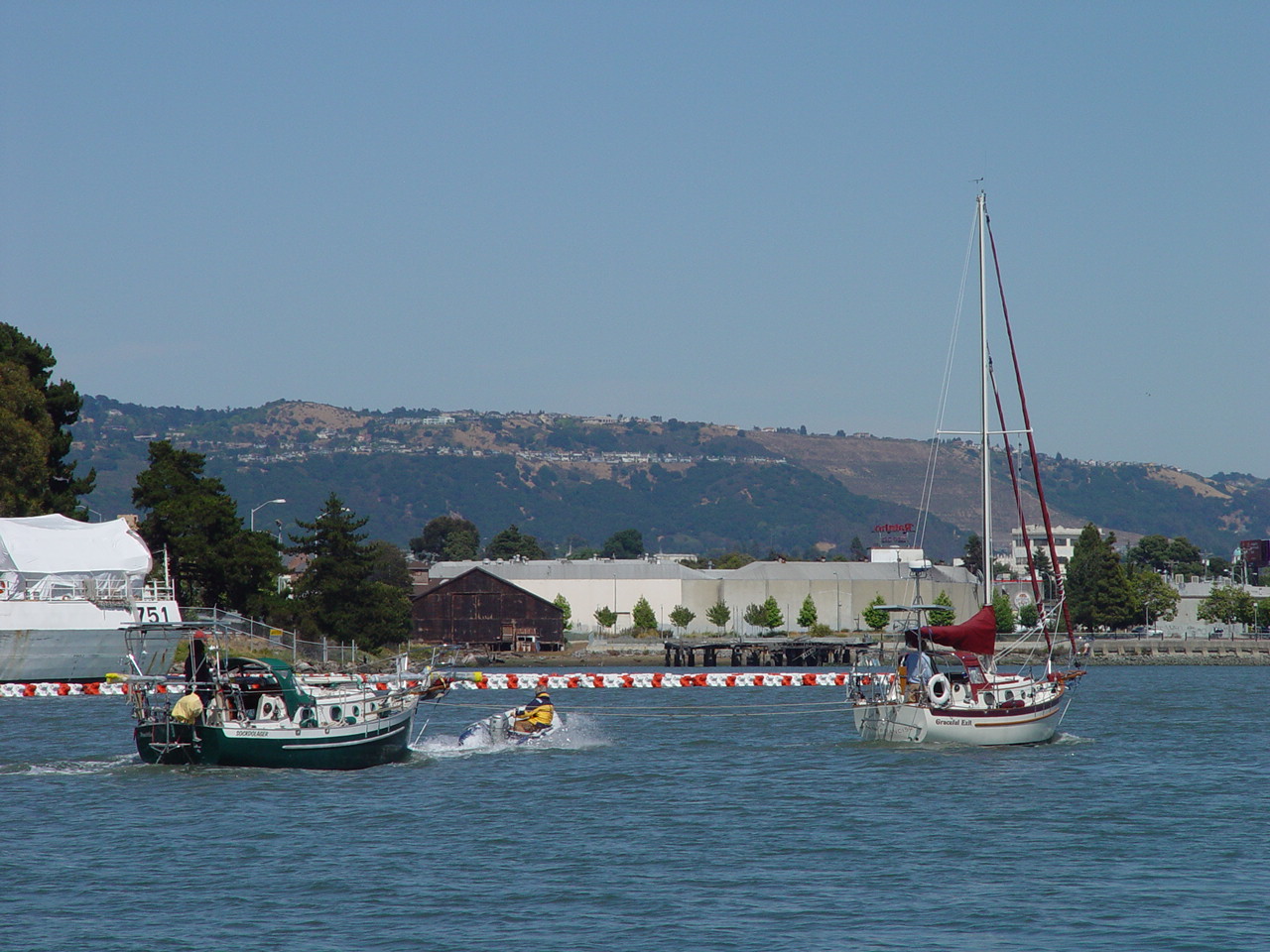 |
| Sockdolager being towed by Graceful Exit down Alameda Channel. Photo by Barbara Boag. |
We arrived at Svendsen’s Boat Works and breathed a sigh of
relief. Laurence and his wife Barbara
kindly invited us to stay with them while we put the boat back together, and we
enjoyed their company very much. In
Svendsen’s mast yard over the next few days, we put all the rigging back on the mast as it lay on some sawhorses,
and Jim installed a new Simrad radar for the return to foggier latitudes.


When it came time to step the mast, we wish we could say it
was a good experience, but it wasn’t. The
owner of this venerable boatyard had died recently, and it seems that perhaps
Svendsen’s may be going through some kind of transition. Several cruising friends have had positive
experiences at Svendsen's, so don’t judge the entire history and reputation of this yard on what
happened to us. However, it did happen, it
deeply angered us, and I am going to tell you about it.
After waiting for two extra days during which the yard refused to give us a time when they’d step our mast, Jim said, “I’m going to
run some errands,” and left. I was aboard
the boat, down below. That’s when the
yard foreman came over, saw me, and said, “Our guys are getting your mast now.” Quickly, I called Jim and walked over to the mast
yard.

We had arranged all the rigging just so for the mast’s trip
from horizontal to vertical, but instead of allowing me to show them what we’d
done, the two yard guys completely took me aback by examining the mast sourly
and repeating at least twice for my benefit, “This mast is all f***ed up!” They also dissed the yard foreman loudly and
in great detail. Their demeanor was so aggressive and nasty that I chose to not speak, waiting instead for them to ask any questions they might have about our mast. They never did. With exaggerated
difficulty, these two placed the mast on two rolling carts and then walked it rapidly
toward the wharf. They didn't control its lateral swing and would have
smashed the masthead with its tricolor and new radio aerial into sawhorses twice had
I not grabbed it and begun guiding it.
The senior yard employee, a short obese older man with the surliest
attitude I’ve ever encountered, looked back at me and scowled in disapproval, but I held on to
our masthead.
The mast stepping process went downhill from there. It was the worst demonstration of sheer
arrogance, poor communication and and gross incompetence we’ve seen. Even Jim had to yell to stop the senior yard
guy after he inexplicably started yanking the new radar cables out from where Jim had
carefully placed them inside the mast.
There’s no need to go into all the icky details but one: rather than tie a tight line from the mast
crane’s lifting loop to a winch to take weight off the tangs when the mast went vertical, this crew lifted
the entire weight of the mast on its tangs, and succeeded in twisting one
seriously enough to make attaching shrouds to chainplates difficult. The yard foreman, upon
seeing what he and his crew had done, insisted to the point of argument,
upon himself going aloft to fix it. “We won’t charge you for fixing it,” he
said.
Incredulous but ignoring that irony, I replied, “Are you kidding? You just fell down in the parking lot yesterday
and broke some ribs. You just got out of
the emergency room last night. You are in no
condition to go aloft!”

The yard foreman told us that for liability reasons they did
not normally allow a yacht to leave the yard with work unfinished. Then he asked, “Will you take the
responsibility of finishing the rigging yourself?”
Deliriously, we said yes, paid their hefty bill, and escaped.
We’re not in the habit of trashing peoples’ businesses, and
would much rather write about good ones we like and recommend, but the two
examples of Svendsen’s in its current state and the agent from Masterpiece
International were so egregious that it would be irresponsible to gloss over
them, because both caused us unnecessary stress and minor but avoidable
damage to hull and rig.
Now we're northbound (at least as soon as the weather clears) and happy again.
Sockdolager had a terrific run from San Francisco up to Crescent City, California, on a wet blustery southerly, and we are now enjoying meeting some interesting people in Coos Bay as everyone waits out the weather.
 |
| Anchored at Port Orford, just south of Cape Blanco |
Today, July 9, marks two years since we left Port Townsend
to sail across the Pacific. We’ve had a
good time, and do not intend to swallow the anchor yet! Lots of wonderful northern sailing beckons.
 |
| Sockdolager at Crescent City, California |


.JPG)


